Selecting for Soft Pastel Zinnia Color
Most gardeners do not struggle to find bright zinnias.
Red, orange, yellow, magenta, hot pink, and cheerful mixed colors are everywhere. They are beautiful in their own way. They belong in summer gardens, pollinator patches, cottage borders, children’s gardens, and bright bouquets.
But some of us are searching for something quieter.
We want zinnias that can sit beside dahlias, roses, lisianthus, cosmos, and heirloom chrysanthemums without shouting over them. We want blush, cream, pale peach, champagne, oatmeal, antique rose, warm ivory, softened apricot, and those unnamed in-between shades that feel more like a wedding bouquet than a summer carnival.
That is the pastel zinnia dream. It is also where selection becomes necessary. Because soft color is not always easy to hold.
A single pastel bloom does not make a pastel line. That is one of the first things a hobby gardener has to understand. You may find one beautiful cream flower, one soft peach bloom, one blush zinnia, or one antique rose plant that feels exactly right. That plant may deserve attention. It may deserve a ribbon. It may deserve its own seed envelope.
But one soft bloom does not mean the next generation will be uniformly soft. Saved seed may produce a range. Some seedlings may return near the parent color. Some may become brighter. Some may move toward peach, ivory, coral, pink, yellow, rose, bronze, or muddy tones. Some may not resemble the parent much at all.
That does not mean the project failed.
It means color selection takes repeated pressure. The goal is not to find one perfect pastel flower and expect it to solve the whole project. The goal is to keep choosing softness, season after season, until the population begins to carry that direction more often.
Every selection project needs a priority. For a pastel zinnia project, the priority is usually softness. That sounds obvious, but it is surprisingly easy to lose. Bright flowers are persuasive. A saturated coral bloom may be gorgeous. A deep rose zinnia may have excellent form. A strong orange plant may be healthy, tall, and productive. A magenta flower may have a perfect stem.
Those plants may be valuable. But they may not belong in the main pastel envelope. If the dream is softness, protect softness. That does not mean every strong color must be discarded. It means strong colors should not automatically be allowed to steer the main line. A deeper color with excellent form, stem strength, or disease tolerance may be worth saving separately. A strong-colored plant can become a side project, a performance line, or a future cross.
But the main pastel seed envelope should be disciplined.
It should not become a collection of every flower you loved.
It should hold the plants whose color you want to see more of.
Pastel is not one color.
Before selecting, it helps to name the color world you are trying to build.
Cream and ivory.
Blush and pale rose.
Peach and soft apricot.
Champagne and warm neutral tones.
Oatmeal, buff, and antique beige.
Dusty rose and muted mauve.
Pale yellow and buttercream.
Watercolor edges, soft fades, or quiet bicolors.
These are related, but they are not identical.
A cream-and-ivory project may need different choices than a peach-and-apricot project. An antique pompon project may welcome buff, bronze, and dusty rose tones that would feel too muddy in a clean blush line. A scabiosa-centered project may allow more color variation if the center form is the main priority.
The more clearly you name the palette, the easier it becomes to choose.
Say, “I want cream, blush, pale peach, champagne, and warm ivory.”
Or say, “I want antique rose, oatmeal, buff, and softened apricot.”
The garden needs a direction before it can answer.
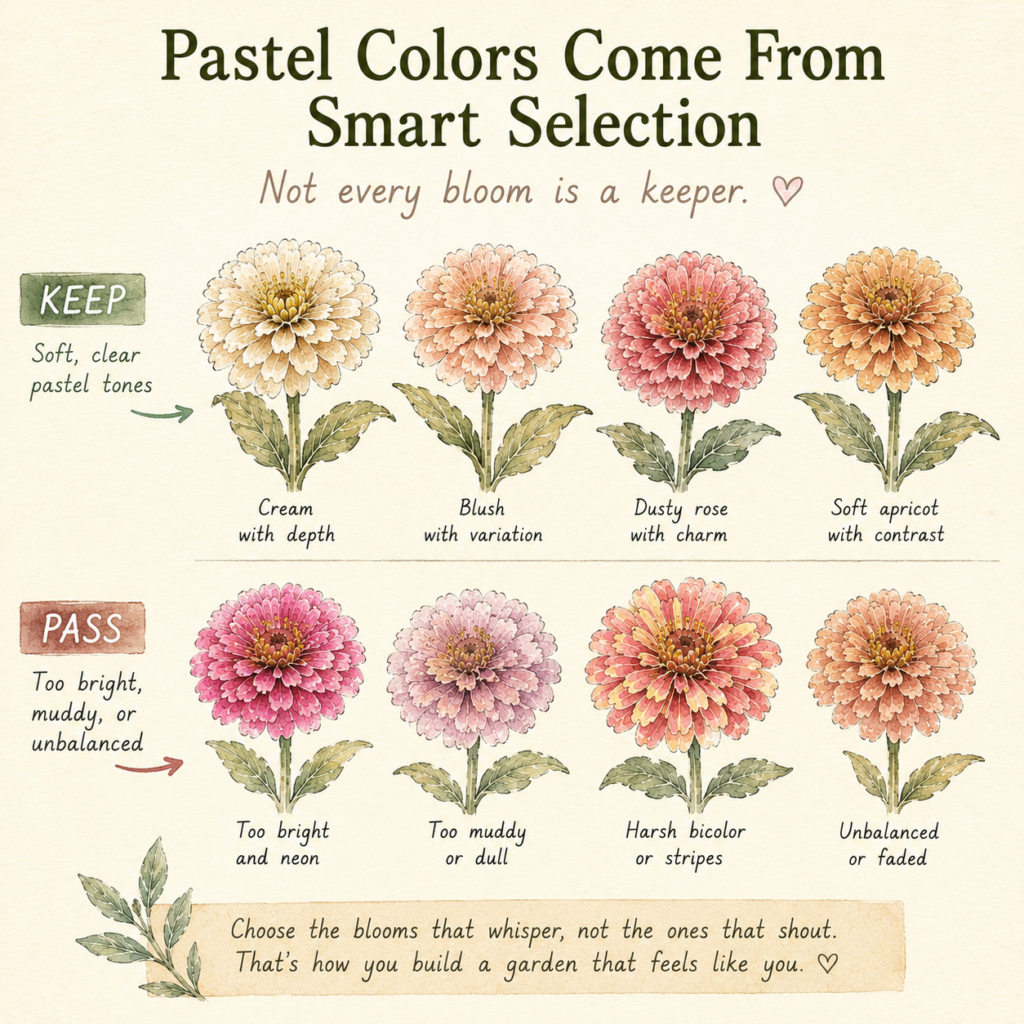
When color is the main priority, choose the right color first.
Then evaluate the plant.
That order matters.
A perfect stem carrying a harsh orange bloom may not move a pastel color project forward. A slightly imperfect but useful cream plant may be more valuable. A soft peach flower with decent stems may deserve more attention than a bright coral plant with excellent vigor.
This does not mean you ignore the rest of the plant.
It means you do not let plant strength seduce you into saving the wrong color for the main line.
But if the plant clearly does not belong in the color world, it should not go into the main pastel envelope. The best pastel selection is not merely the softest flower. It is the best whole plant among the flowers that protect the palette.
A zinnia’s first-open color is not the whole story. Some flowers open beautifully and then fade into something even better. A peach bloom may soften into champagne. A blush flower may become antique rose. A cream flower may pick up a pale edge. A warm apricot may fade toward oatmeal or buff.
Other flowers move the opposite way. A bloom that opens promisingly soft may become muddy, harsh, dull, or uneven. A pale yellow may age into a color that does not suit the project. A coral may become too saturated. A pink may become hot and ordinary.
Do not judge too quickly. Photograph the bloom when it opens. Photograph it again a few days later. Notice whether the aging process makes the flower more useful or less useful. For romantic zinnia work, the fade can be part of the beauty.
Some of the most interesting pastel flowers are not static. They shift. They soften. They look different in morning light than they do in late afternoon. They become more complex as they age.
Those flowers are worth watching carefully.
Some colors are beautiful but dangerous to the project.
They are dangerous not because they are bad, but because they can pull the population away from softness.
Examples:
These plants may contain useful traits. The mistake is putting them into the main pastel envelope without thinking.
Instead, save them separately.
“Bright coral — excellent form — not main pastel.”
“Hot pink — strong stem — possible future cross.”
“Orange survivor — August performance — separate.”
This preserves information without confusing the main project.
A separate envelope says, “This plant may be useful later.”
The main envelope says, “This plant belongs to the dream now.”
Avoid Muddy Pastels Unless They Serve the Project
Not every muted color is a good pastel.
This is important. Some zinnias fade beautifully into antique, complex, florist-friendly tones. Others simply become muddy. The difference can be subtle, but it matters. A good muted color still feels intentional. It can sit in a bouquet beside cream, blush, peach, apricot, lavender, brown foliage, or heirloom-style flowers and make the palette richer.
A muddy color feels confused. It may make the bouquet look tired rather than antique. That does not mean you must reject every dull or complex shade. Buff, oatmeal, bronze-peach, dusty rose, and muted apricot can be valuable in the right project. But they should be chosen deliberately.
Does this color look romantic or merely faded?
Does it improve as it ages?
Does it combine well with the other colors I want?
Would I want more plants in this color family?
If the answer is no, enjoy the flower and move on.
For pastel color selection, seed organization matters.
At the end of the season, do not throw every interesting seed head into one bag.
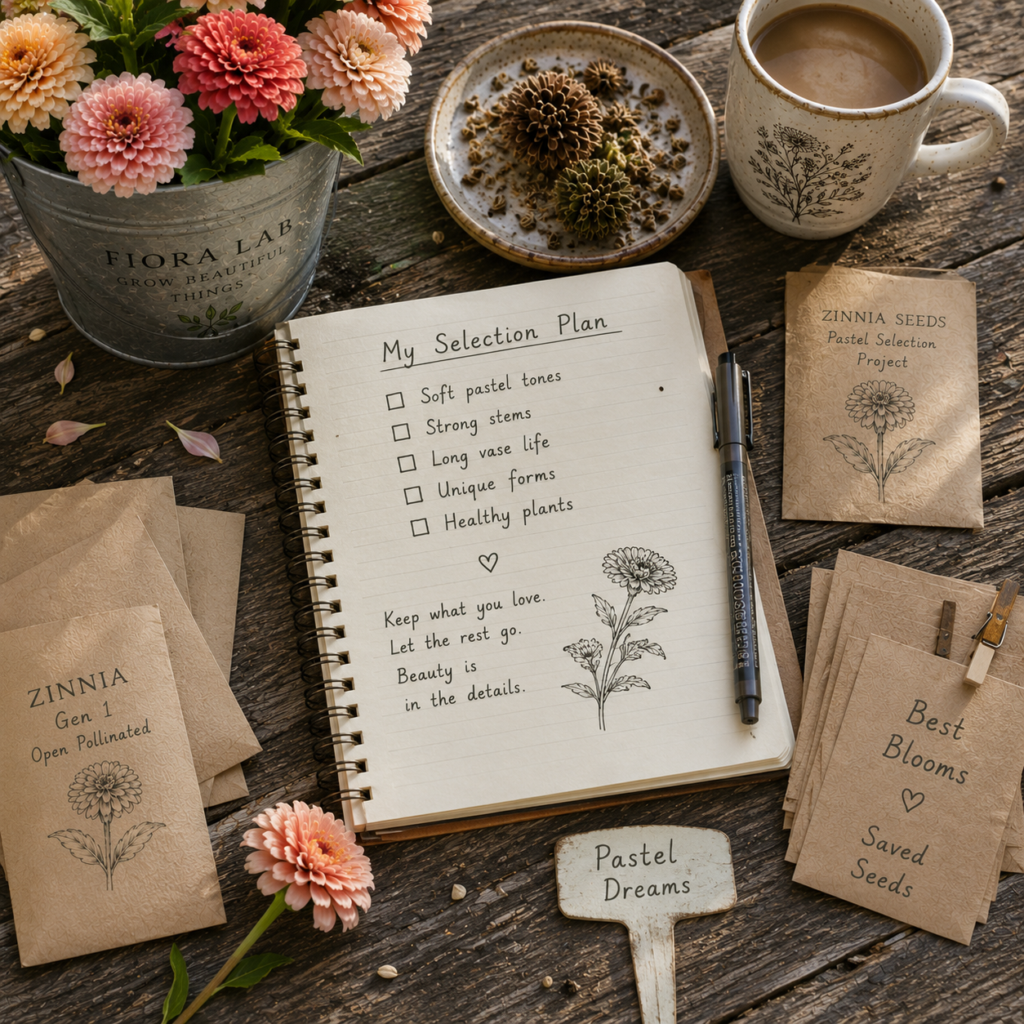
Main Pastel Line
This envelope is for plants that clearly fit the color direction and are good enough as whole plants to deserve another season.
Side Saves
These are separate envelopes for plants with one interesting trait that should not yet enter the main line.
Side saves might include:
This system keeps the main line clean while allowing curiosity. That balance is important. A pastel project needs discipline, but it should not become so rigid that you throw away every clue.
Color expectations should be honest. A useful way to think about saved zinnia seed is: likely, possible, and unlikely.
If you save seed from several soft pastel plants in a mostly soft pastel row, more soft colors become likely.
If you save seed from one cream flower growing near many bright colors, cream seedlings are possible, but a uniformly cream family is unlikely. If you save from a cream flower with a purple edge, the edge may be possible, but every seedling showing the edge is unlikely.
This way of thinking keeps hope and realism in the same envelope. It also helps with product honesty. Early-generation zinnia seed should not be described as if every seed will produce the dream flower. It should be described as a population with a direction.
“Selected from soft cream, blush, peach, and champagne-toned plants. Expect variation. Save from the softest, strongest plants.”
That is honest.
And it invites the gardener into the work.
Pastel color selection depends on having enough plants to compare. If you grow only three plants, you may not see much of the range. If you grow ten, you can begin. If you grow twenty-five, you have more choices. If you grow fifty or more, the project becomes stronger.
But the best number is still the number you can actually observe. A hundred plants ignored are less useful than twenty-five plants watched carefully. The important thing is to grow enough that color differences become visible. You need to see which plants are too bright, which are too muddy, which are promising, which hold color well, and which combine softness with better stems and plant habit.
A pastel project is built by comparison. Not by one flower alone.
Color is easily distorted. A zinnia can look different in morning sun, harsh midday light, shade, evening warmth, or under a phone camera that exaggerates saturation. If you are selecting for subtle pastel tones, try to photograph plants in consistent light.
Morning or late afternoon light is often more forgiving than harsh midday sun. Open shade can help show color without glare. Include a plant tag in the photo when possible. Photograph the same bloom more than once as it ages.
You do not need professional images for selection. You need useful records. A simple photo can remind you whether the bloom was cream, pale peach, warm ivory, or actually stronger than you remembered. Memory edits color.
Photos help keep you honest.
A flower that looks beautiful in a bouquet may not be the best seed parent. Bouquets are edited. The gardener can hide weak stems, remove bad leaves, combine colors carefully, and place the best bloom forward. The seed parent has to be judged in the garden.
Does the plant itself carry the color well? Does it repeat the bloom? Does it produce enough flowers? Does it stay reasonably healthy? Does it still belong in the project when you are not arranging around its flaws? A vase can show you whether a color is useful. But the plant tells you whether the color deserves another season. Use both.
For the main pastel line, favor plants that combine several of these traits:
Soft color that clearly belongs to the palette.
Color that ages beautifully.
A bloom form worth seeing again.
A stem strong enough to hold the flower.
Reasonable branching.
Foliage that does not fail too early.
Enough vigor to keep contributing.
Seed production from a plant you actually selected.
You do not need every trait to be perfect.
But the plant should move the project forward.
A cream flower on a weak plant may still be saved separately. A blush flower with good stem strength may go into the main line. A pale peach plant with excellent aging color and decent vigor may be worth choosing even if the bloom form is not perfect yet.
Selection is not about finding flawless plants.
It is about choosing the best available parents for the next question.
For a soft pastel zinnia project, the rule is simple:
Give softness more votes. That means saving seed from soft plants more often than bright ones. It means keeping the main envelope focused. It means not letting every pretty flower enter the line. It means growing enough plants to compare, marking the best ones, watching color as it ages, and saving seed from the plants that still fit the dream after the first excitement fades.
Pastel work is patient work.
A single bloom may begin the project.
Repeated selection builds it.
Fiora Lab pastel zinnia seed is offered as early-generation selection material. Variation is expected. The goal is not to grow a row of identical flowers from every seed. The goal is to grow a population with soft color possibilities, then select the plants that deserve another season.
Grow the row. Mark the softest useful plants. Keep strong colors separate. Save seed with intention.