By fioralab Share
Facebook
X-twitter
Linkedin
Pinterest
The Antique Pompon Zinnia Project
The Antique Pompon Zinnia Project is about shape first.
Color matters. Stems matter. Foliage matters. Productivity matters. Late-season performance matters. But the heart of this project is bloom form: rounded, full, warm, structured, and useful.
This project is inspired by the feeling of old ball dahlias and antique florist flowers. The goal is not to make a zinnia stop being a zinnia. A zinnia should still have its own character. But it can move toward that same useful shape: compact, domed, layered, and easy to place in arrangements.
These are not meant to be the largest zinnias in the garden.
A smaller rounded bloom may be more useful than a huge flat flower.
In a vase, shape often matters more than size.
Every Fiora Lab project needs a question.
Does this flower have the rounded form that makes the project recognizable?
If the answer is yes, mark it.
Not every pretty flower belongs in this line. Not every pastel flower belongs in this line. Not every double flower belongs in this line.
The Antique Pompon Project is not only selecting for softness or fullness. It is selecting for a particular kind of fullness: rounded, compact, domed, balanced, and bouquet-friendly.
A flower can be full but flat.
A flower can be double but messy.
A flower can be beautiful but too large, too loose, too bright, or too awkward for this project.
The project becomes clearer when the gardener learns what to reject.
Rounded bloom form.
Domed or ball-like profile.
Dense but attractive petal arrangement.
Warm antique color.
Good symmetry.
Useful stems.
Strong branching.
High flower production.
Acceptable late-season health.
That is the full dream.
You may not find all of it at once.
In the first year, the project may begin with any plant that clearly moves toward rounded form. The color may not be perfect. The plant may not be perfect. But the shape should be present enough to justify saving.
By the second year, the standard should rise. Rounded flowers should repeat more often. The color world should begin narrowing. Plants with better stems and productivity should be favored.
By the third year, the main seed lot should come from the most complete plants: rounded form, useful antique color, decent stems, enough vigor, and enough health to keep producing.
This project asks for patience because form takes repetition.
A double zinnia is not automatically a pompon zinnia.
This distinction matters.
Many zinnias have extra petals. Some are semi-double. Some are fully double. Some are large and dahlia-like. Some are crested or irregular. Some are very full but still look flat when viewed from the side.
It asks:
Does the bloom look round?
Does it have depth?
Does it hold a domed shape?
Does it look balanced from the front and side?
Does the center stay attractive?
Does the form repeat on later flowers?
A flower can be double and still fail this project.
A flower can be moderately full but very rounded and deserve attention.
More petals are not always better.
Better shape is better.
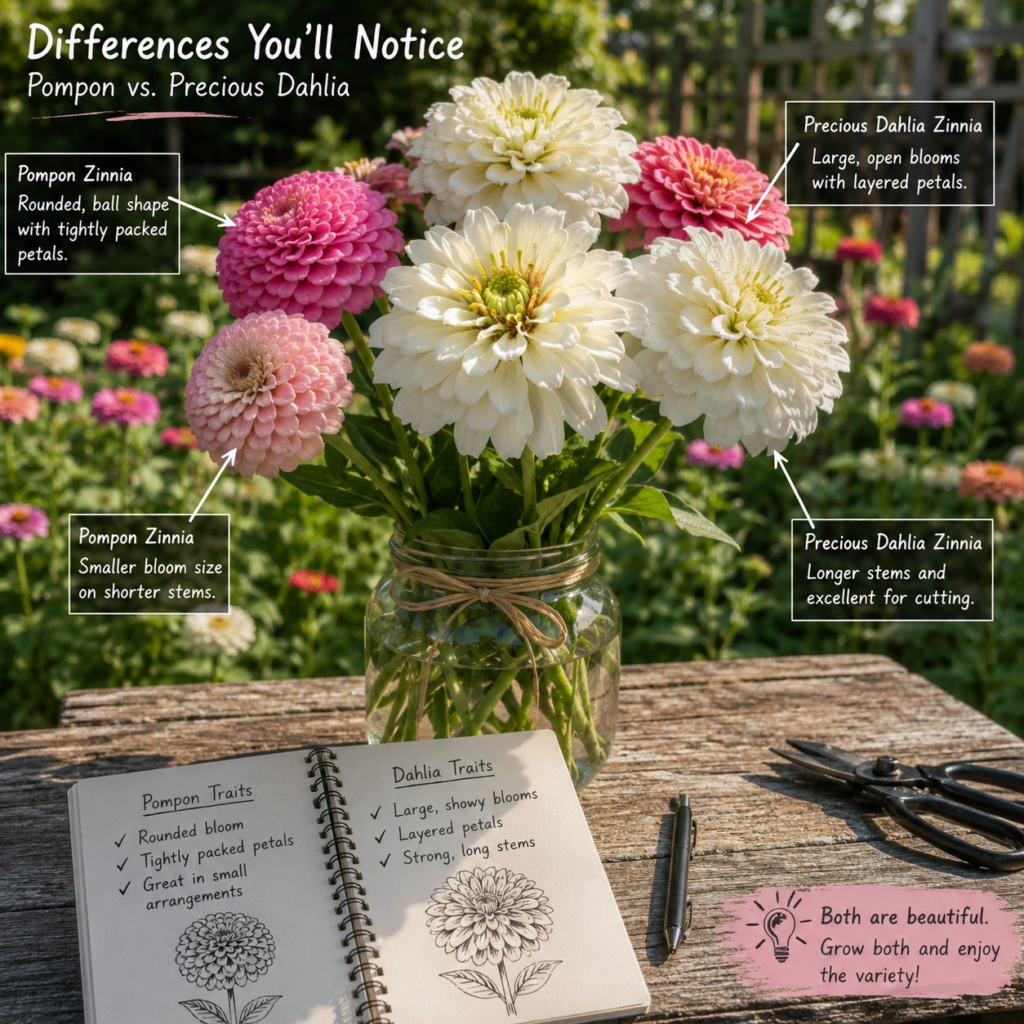
For this project, the side view is essential.
A bloom may look charming from the front and disappointing from the side. It may photograph well as a flat face but lack the depth needed for a true pompon direction.
When evaluating a candidate, look at the flower from several angles.
From the front:
Is it balanced?
Is the center attractive?
Are the petals arranged well?
Does the bloom feel intentional?
From the side:
Is it rounded or flat?
Does it have a dome?
Does it look like a small ball, button, or compact florist form?
Does the neck hold it well?
Does it remain attractive in three dimensions?
A good Antique Pompon candidate should feel useful in a bouquet, not only interesting in the garden.
The color world for this project is warm, muted, and nostalgic.
Think oatmeal, buff, bronze-peach, old rose, warm cream, muted apricot, faded coral, dusty pink, antique salmon, tea-stained peach, and soft neutral tones that look like they already belong in a vase with dahlias, roses, grasses, and seed heads.
This project should avoid harsh brightness.
Clear orange, neon pink, red-orange, strong magenta, bright yellow, and high-contrast bicolors may be beautiful, but they do not belong in the main Antique Pompon direction unless you are intentionally creating a separate line.
Antique color is not the same as muddy color.
That distinction matters.
An antique tone feels softened, aged, warm, and usable.
A muddy tone feels dull, unclear, or dirty.
If you are not sure, put the flower beside cream, green foliage, and a few softer blooms. If it makes the group feel richer, it may be antique. If it drags the group down, it may be muddy.
Muted should still feel alive.
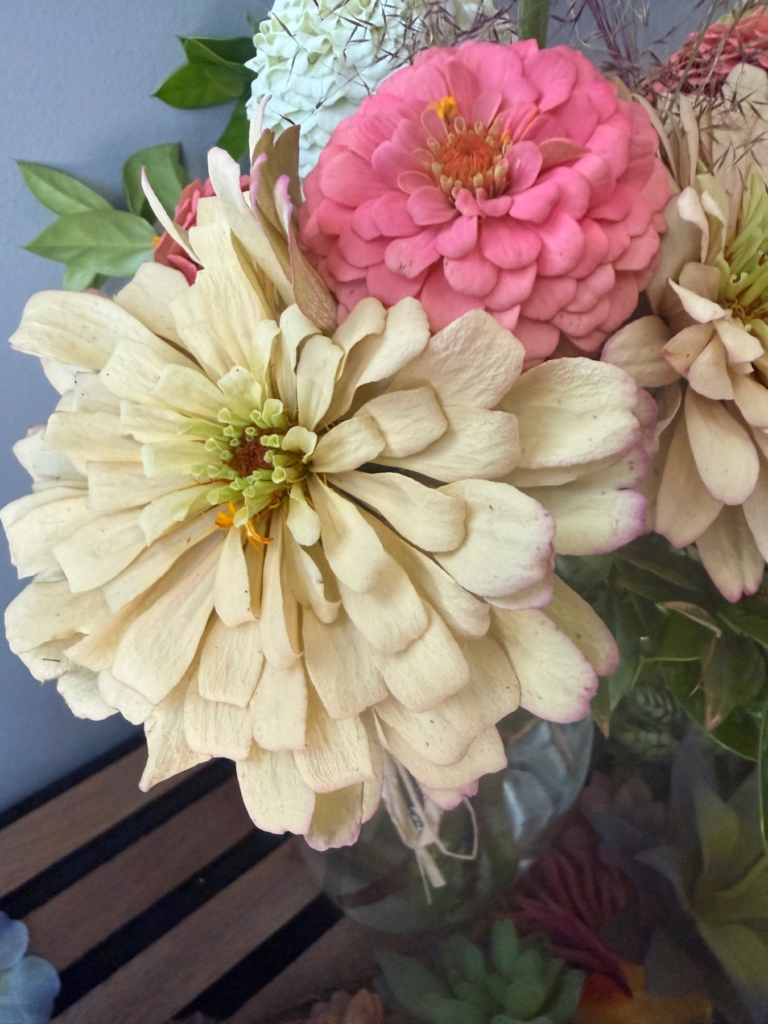
For this project, mark warm cream if the form is rounded enough. Cream can become an important balancing color in arrangements and may help soften the whole line. Mark oatmeal or buff when the bloom has depth and does not look dull. These colors can be sophisticated, but they must be carried by good form.
Mark bronze-peach and muted apricot when they stay soft rather than turning orange. These tones can give the project warmth without making it loud. Mark old rose, dusty pink, and faded coral when they feel antique rather than bright. If the pink leans too hot, save separately or reject it from the main line.
Mark unusual fades if the mature flower becomes more beautiful with age. Antique projects often benefit from colors that soften gracefully. Do not rely only on the first color.
Photograph the bloom when it opens and again a few days later. A flower that ages into the right tone may be more valuable than one that opens well and fades poorly.
A project becomes stronger when the gardener knows what does not belong.
For Antique Pompon, reject flat blooms unless they carry a rare trait worth saving separately.
Reject loose flowers that never develop depth.
Reject flowers with messy, unattractive petal arrangement.
Reject harsh colors from the main line.
Reject weak stems if the plant has no exceptional form.
Reject early mildew and poor foliage when stronger candidates are available.
Reject plants that produce one rounded bloom and then return to ordinary form.
Do not save a plant for this project simply because it is pretty.
The main question is not:
Do I like this flower?
The main question is:
Does this flower make the Antique Pompon direction clearer?
If it does not, enjoy it and move on.
A rounded flower is most useful when the plant can hold it.
The Antique Pompon Project should not become a collection of charming little blooms on weak, short, or awkward stems. The flowers should be useful in jars, small bouquets, mixed arrangements, and seed-saving work.
Strong enough to hold the bloom.
Long enough to cut.
Not so floppy that the flower faces the ground.
Not so short that the bloom disappears in the foliage.
Not so thick and coarse that the flower becomes awkward in small arrangements.
The perfect stem may not appear immediately. In early generations, you may keep a rounded flower with only decent stems because the shape is rare. But as the project develops, stems should become part of the selection pressure.
A pompon bloom needs a plant that can carry it.
A rounded flower is most useful when the plant can hold it.
The Antique Pompon Project should not become a collection of charming little blooms on weak, short, or awkward stems. The flowers should be useful in jars, small bouquets, mixed arrangements, and seed-saving work.
Strong enough to hold the bloom.
Long enough to cut.
Not so floppy that the flower faces the ground.
Not so short that the bloom disappears in the foliage.
Not so thick and coarse that the flower becomes awkward in small arrangements.
The perfect stem may not appear immediately. In early generations, you may keep a rounded flower with only decent stems because the shape is rare. But as the project develops, stems should become part of the selection pressure.
A pompon bloom needs a plant that can carry it.
This project should not depend on one perfect flower.
A good Antique Pompon plant should produce enough rounded blooms to be useful. The blooms are not meant to be one-time curiosities. They should be useful in bunches, jars, arrangements, and repeated cutting.
A plant that makes several rounded blooms on usable stems may be more valuable than one plant that produces one perfect flower and then stops.
Watch:
Does the plant branch after cutting?
Do later blooms keep the rounded form?
Are there enough stems to use?
Does the plant stay productive into the season?
Does the form repeat, or was the first bloom the only good one?
The Antique Pompon Project is not only about finding a flower.
It is about building a plant that can keep making that kind of flower.
A beautiful rounded zinnia that collapses early may still be worth saving separately, especially if the form is rare.
But the main line should become stronger over time.
Late-season performance matters because a hobby gardener needs plants that remain useful after the easy part of summer has passed. Heat, humidity, storms, pests, and powdery mildew pressure can reveal which plants are only early beauties and which ones can keep working.
The Antique Pompon Project should borrow some discipline from the August Survivor mindset.
Ask:
The goal is not spotless foliage.
The goal is comparative usefulness.
An Antique Pompon candidate is better if it remains useful late.
Not every interesting plant should go into the main Antique Pompon seed lot.
Use separate envelopes for plants that have one strong trait but do not fully belong yet.
Examples:
A very rounded bloom in a harsh color.
A warm cream flower with weak stems.
A dusty rose bloom with good form but poor productivity.
A plant with excellent branching but only semi-rounded flowers.
A rounded bloom that appears once and does not repeat.
A rare color that may be useful later but is not ready for the main line.
Separate envelopes let you test a plant without letting it confuse the whole population.
The main envelope should hold the plants that make the Antique Pompon direction clearer.
The side envelopes hold questions.
Both are useful.
Good labels make the project easier next year.
Use short, honest notes.
Examples:
“Antique Pompon — warm cream — rounded — good stem.”
“Buff round form — save separately — weak plant.”
“Old rose pompon — good repeat bloom.”
“Bronze-peach — excellent form — too bright? test.”
“Rounded but flat side view — caution.”
“Strong plant — semi-rounded — maybe family.”
These notes do not have to be elegant. They need to be useful.
Next year, when the seedlings grow, you want to remember why the seed was saved.
Use four categories.
Plants with rounded form, useful antique color, decent stems, and enough productivity to deserve another generation.
Plants with promising shape but a weakness that needs more observation.
Plants with one rare or valuable trait that should not yet enter the main line.
Pretty flowers that do not make the project clearer.
This system keeps the line focused while allowing curiosity.
That balance matters because Antique Pompon is both a form project and a color project. If you save everything, the line becomes scattered. If you reject too aggressively, you may lose useful clues.
Shape first, but not shape alone.
The project begins with rounded form, but the best plants will also carry useful color, decent stems, productivity, and enough health to continue.
Do not choose the largest bloom just because it is impressive.
Do not choose the fullest bloom if it is flat, messy, or weak.
Do not choose the prettiest antique color if the shape does not belong.
Choose the plants that make the future of the project easier to recognize.
That is how an early-generation line starts to become itself.
Not by saving every beautiful flower.
By choosing the flowers that clarify the dream.
Fiora Lab Antique Pompon is an early-generation, open-pollinated zinnia selection line focused on rounded, full, antique-toned blooms. It is selected toward warm cream, oatmeal, buff, pale peach, soft bronze, muted rose, and softened apricot, but it is not a finished uniform variety. Variation is expected.
Grow the row. Mark the roundest useful blooms. Watch the side view. Save from the plants that make the Antique Pompon direction clearer.