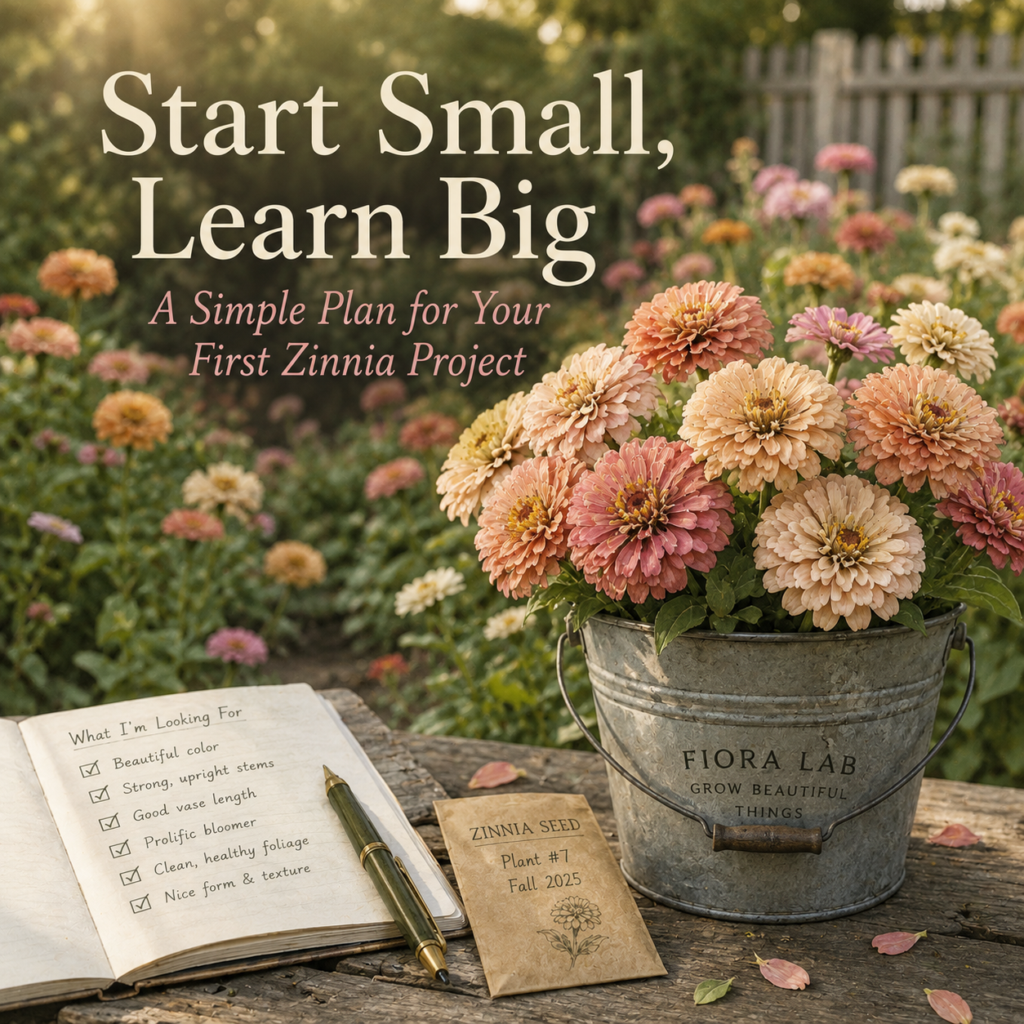
At first, every zinnia project begins with the bloom.
That is natural. The flower is what makes us stop. The softest color, the fullest form, the strange center, the cream bloom with a faint edge, the flower that looks better than anything else in the row — of course that is what catches the eye first.
Most gardeners begin by thinking, I want to save seed from that flower. But as soon as you become a selector, the question has to change. You are not only saving from a flower. You are saving from a plant.
That difference matters because a beautiful bloom can sit on a weak stem. A perfect color can appear on a plant that mildews early. A full double flower can come from a plant that barely produces. A rare color can be attached to poor branching, short stems, or a plant that collapses before the rest of the row is tired.
The bloom matters. But the bloom is not the whole story. The Flower Gets Your Attention. The Plant Earns the Seed Envelope. In a backyard zinnia project, the flower is the invitation.
The plant is the decision. A flower may make you stop, but the plant has to keep your attention. Before saving seed, look at what supports that bloom:
This is one of the hardest lessons in backyard breeding. Pretty is not always enough. A flower can be beautiful and still not be the best seed parent. It can be the one you photograph the most, the one you show a friend, the one you cut for a vase, and still not be the plant that should shape the next generation.
That does not make the flower worthless. It can still be enjoyed. It can still go into a bouquet. It can still be part of the garden’s beauty. But seed saving asks a different question.
Not: Do I like this flower?
But: Do I want more plants like this one next year?
Those are not the same question.
A plant with a rare pastel bloom but weak stems may be worth saving separately as a side project. A plant with an ordinary flower but excellent health and strong stems may be worth watching for performance. A plant with a beautiful bloom and poor disease resistance may be better enjoyed in the vase and left out of the seed-saving plan.
Selection requires admiration, but it also requires judgment.
My physical therapist brain follows me into the garden.
In the clinic, one good movement does not tell the whole story. I want to know whether the person can repeat it. I want to know what happens under fatigue, under load, and over time. I want to know whether the surrounding system supports the movement or whether the movement only looked good once.
Plants are not people, but the habit of observation is similar. One perfect bloom does not tell the whole story. A zinnia bloom is supported by the stem beneath it, the neck holding it, the leaves feeding the plant, the roots taking up water, the branching pattern that determines productivity, and the plant’s ability to keep going after the easy part of the season is over.
A perfect flower on a poor plant is information. A slightly imperfect flower on a strong, healthy, productive plant is also information.
The work is learning how to see the difference.
That is why Fiora Lab keeps returning to one rule:
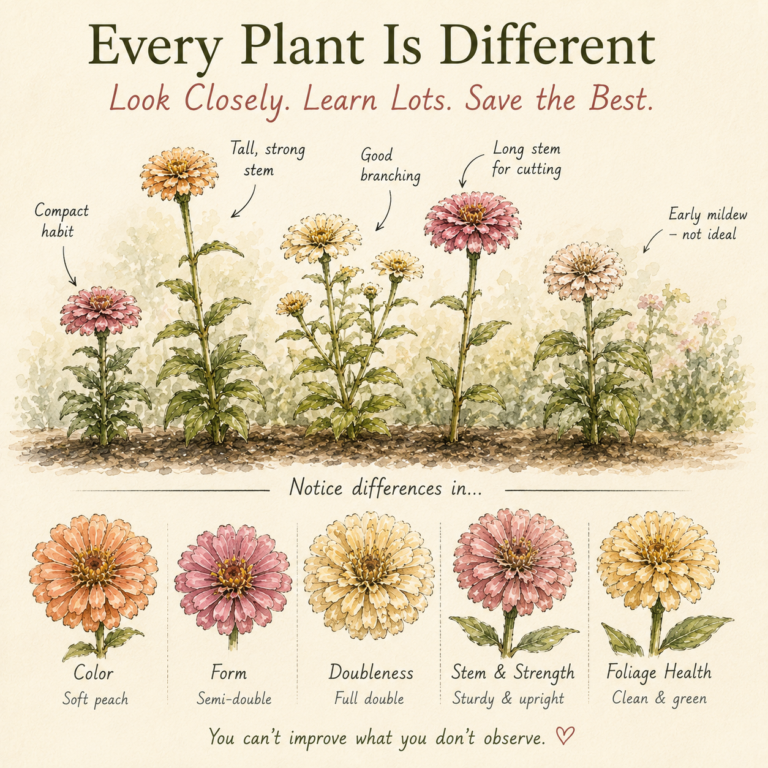
Does the color fit your project?
For a pastel zinnia project, this may mean blush, cream, pale peach, champagne, oatmeal, antique rose, warm ivory, soft apricot, or another quiet in-between shade. A bright flower may be beautiful, but if it pulls the project away from the goal, it should not go into the main pastel seed line.
Is the bloom single, semi-double, fully double, dahlia-like, pompon-like, cactus-like, scabiosa-centered, or irregular?
Form matters, but it should not be judged alone. A full bloom on a weak plant may be less useful than a slightly less perfect bloom on a stronger plant.
Can the stem hold the flower?
Large pastel blooms are only useful if the plant can support them. A bloom that faces the ground, folds after rain, or flops in the vase may still be beautiful, but it tells you something about the plant.
Does the plant stay reasonably clean for the season?
Zinnias are not immune to powdery mildew, leaf spots, or late-season decline. The goal is not perfect foliage forever. The goal is to notice which plants decline first and which plants remain useful longer.
Does the plant still deserve attention when the row is tired?
This is where many selections become clearer. Early beauty is valuable, but late-season usefulness is often more revealing. A plant that still looks alive, productive, and worth cutting in August or September may deserve special attention.
Does the plant keep producing?
One beautiful flower is exciting, but a backyard project should also pay attention to how the plant behaves after cutting. Good branching and repeat bloom make a zinnia more useful in the garden and in the vase.
The neck is the area just below the bloom. This is where many zinnias fail as cut flowers. A weak neck makes even a beautiful flower difficult to use. For bouquet work, a strong bloom needs a strong connection to the stem.
Do not wait until the garden is brown and dry to decide what was good. By the time seed heads mature, the row may look tired and confusing. The flower that made you stop in July may not be recognizable later. Memory is unreliable in a busy garden.
Mark the plant while it is still showing you why it matters. Use a ribbon, a stake, flagging tape, a plant tag, or a small label. Take a photo of the flower and the whole plant. Photograph the label with the plant so you know what you are looking at later.
Write a short note before the details disappear:
These notes do not need to be perfect. They need to be useful.
The goal is to prevent guessing later.
01
A Yes plant clearly fits the project direction. It has enough good traits to deserve seed-saving attention. Mark it, photograph it, watch it again, and save seed if it continues to hold up.
02
A Maybe plant has one important trait but also a question. Maybe the color is rare, but the stem is weak. Maybe the form is excellent, but the plant is short. Maybe the foliage is strong, but the flower is not quite right. Maybe plants are useful because they teach you what is possible, but they should often be saved separately.
03
A No plant may still be beautiful. It may be cheerful, useful in bouquets, attractive to pollinators, or fun to grow. But it should not shape this project.
This system keeps you from saving too much.
It also keeps you from throwing away something interesting too quickly.
This is important. Not every beautiful zinnia needs to become a parent. Some flowers are for cutting. Some are for photographing. Some are for giving away. Some are for the bees. Some are for learning what you do not want to carry forward.
A bright orange flower in a pastel project may still be gorgeous in the garden. A single bloom may still feed pollinators. A short-stemmed flower may still be charming at the edge of a bed. A strange off-type may still be worth a photo.
But seed saving is not the same as appreciation. Seed saving is a vote.
When you save seed, you are saying, I want this plant to have influence next year.
So vote carefully.
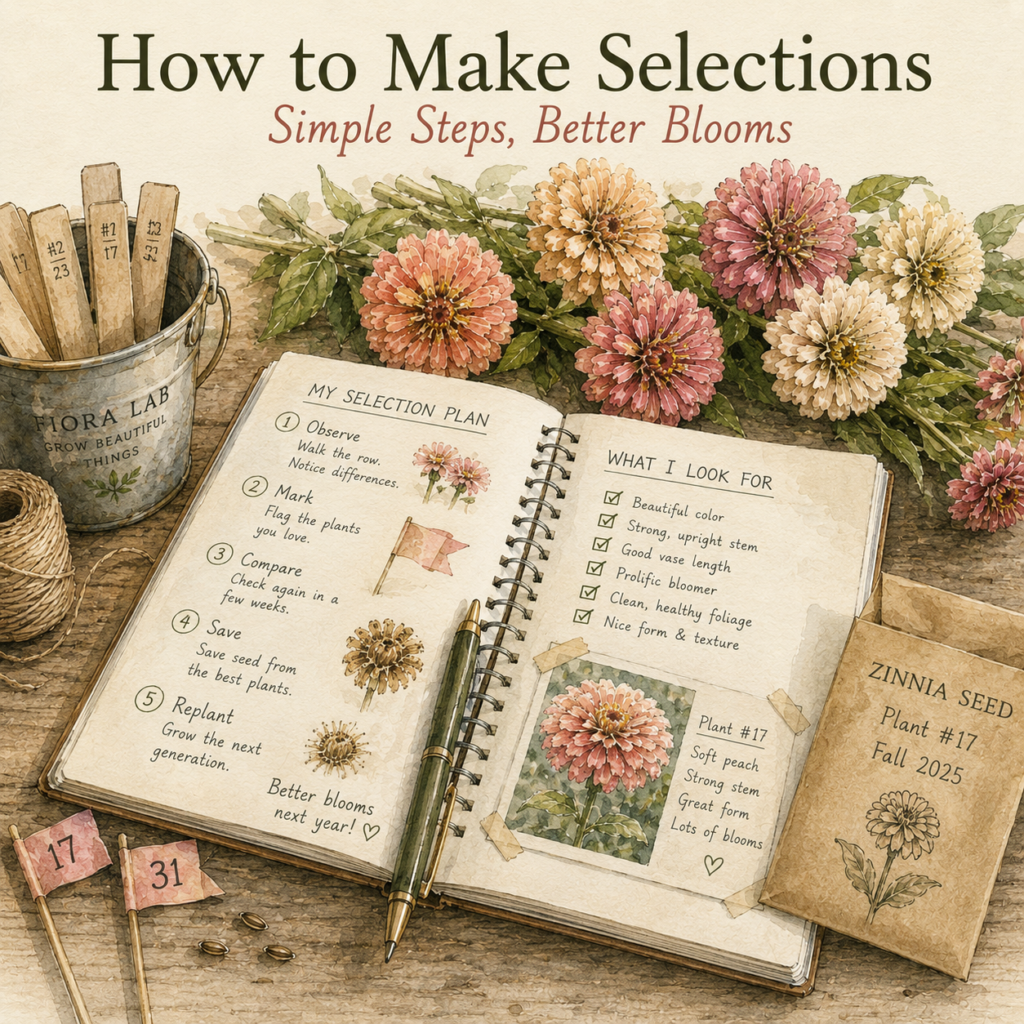
Some plants should not go into the main seed envelope, but they should not be discarded either.Save separately when a plant has one rare or valuable trait but does not fully match the main project.
Examples:
Separate envelopes allow you to test these plants without letting them steer the whole population. That is one of the best habits a hobby selector can build.
A group envelope says, these plants all fit the main direction. A separate envelope says, this plant deserves to be studied on its own. Both are useful.
At the end of the season, the easiest seed to collect is not always the best seed to save.
This is one of the traps of casual seed saving. The best flowers may have been cut. The strongest plants may have been deadheaded. Meanwhile, the plants left standing may be the ones no one wanted to cut, the ones with poor color, weak stems, disease, or awkward form.
If you collect seed only because it is available, the population may drift in the wrong direction. Seed should come from plants that were chosen while they were alive and performing.
That is why marking matters.
The seed head should be the result of a decision, not the result of forgetting.
A better zinnia is not always a perfect zinnia.
In a hobby project, better may mean:
Progress may be subtle. It may not look like a catalog photo. It may look like a better envelope, a clearer note, a slightly stronger family, or one plant that combines two traits you had only seen separately before.
That is still progress. Backyard selection is a season-by-season practice. The goal is not to demand perfection from one plant. The goal is to keep choosing in a direction.