By fioralab Share
Facebook
X-twitter
Linkedin
Pinterest
Selecting for Double Zinnia Blooms
Double zinnias are the flowers many gardeners want most. They look full, romantic, generous, and useful in bouquets. They photograph beautifully. They can make a zinnia feel less like a common summer annual and more like a florist-style flower that belongs beside dahlias, roses, lisianthus, and heirloom chrysanthemums.
But double blooms can also be confusing. A plant may produce one full flower and then never repeat it. A bloom may look double from the front but shallow from the side. A flower may be full but messy, crowded, weak-necked, or poor at making seed. A seed saved from a double flower may produce doubles, semi-doubles, and singles the next year.
That does not mean the project failed.
It means doubleness is selected over time.
A double bloom is not a promise. It is a direction.
When hobby gardeners say a zinnia is double, we usually mean the flower looks full.
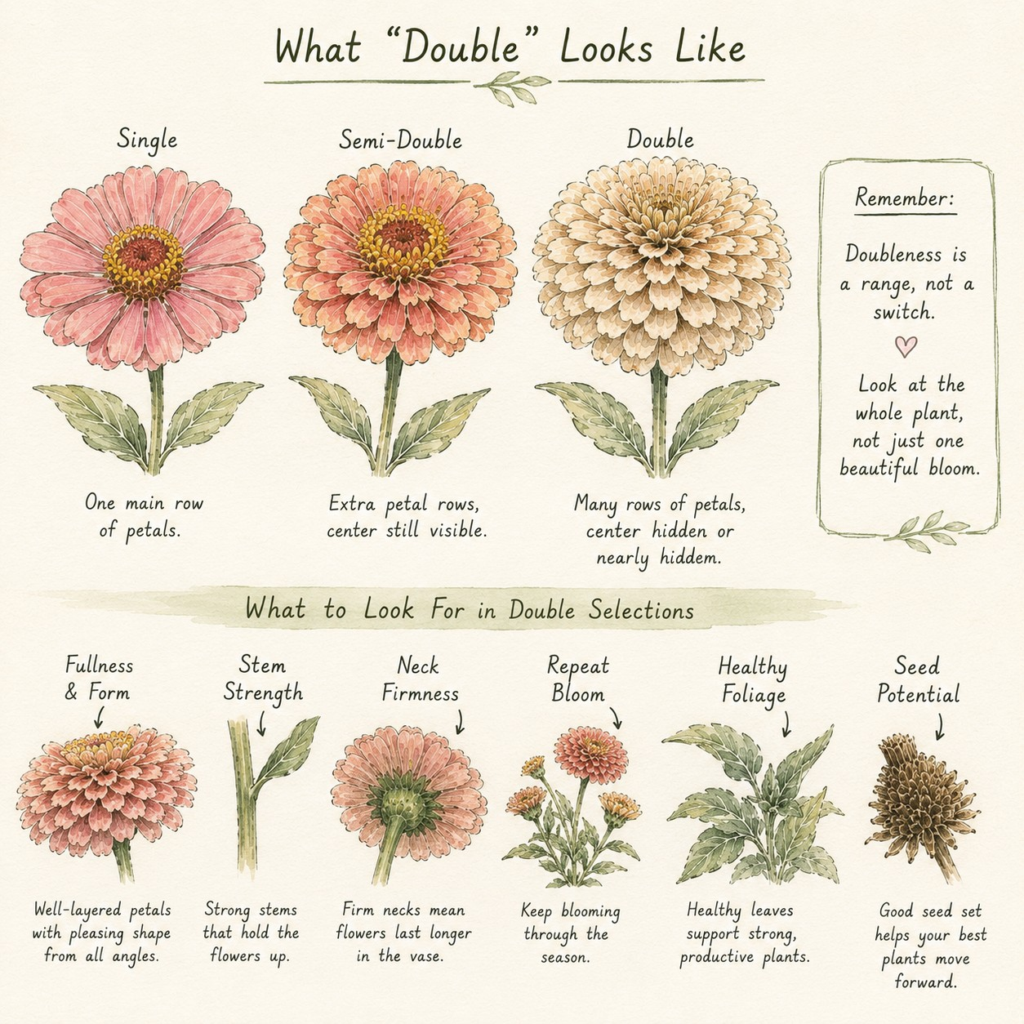
A single zinnia has one main row of petals around a visible center.
A semi-double zinnia has extra petal rows, but the center is still visible.
A fully double zinnia has many rows of petal-like florets, often hiding most or all of the center.
Those categories are useful, but they are not always perfectly clean. Some flowers sit between semi-double and double.
Some blooms are full at the outer edge but flat in the center. Some plants produce fuller flowers later in the season than they did at first. Some flowers look technically full but unattractive because the petals are stiff, crowded, uneven, or poorly arranged.
Is this the kind of fullness I want to see again?
That question is more useful than arguing with the flower.
Double zinnias can move in different directions.
A large pastel project may want broad, layered, dahlia-like fullness. An antique pompon project may want smaller, rounder, more domed flowers. A scabiosa project may want a raised center with enough surrounding petals to make the bloom feel complete.
A cut-flower project may want fullness, but not at the cost of stem strength, neck firmness, or vase usefulness.
This is why “double” should not be treated as a single goal. Before selecting, decide what kind of double you want.
Your project direction changes which flowers deserve seed.
One beautiful double bloom is enough to mark a plant. It is not always enough to save from it. Some zinnias open one impressive first flower and then produce weaker blooms. Others begin modestly and improve as the plant branches and matures. Some make one full bloom because conditions happened to be favorable, but the plant does not repeat the trait.
Repetition matters.
One double bloom may be a beautiful accident. A plant that keeps making good double blooms is more useful.
This is where many beginners get tricked. A double flower can be full and still be wrong for the project.
It may have the wrong color. It may be poorly shaped. It may have a weak neck. It may be short-stemmed. It may mildew early. It may make only one useful flower. It may be so full that seed is difficult to find. It may look wonderful in a photo but disappoint in a vase.
A good double selection should still be judged as a whole plant.
A double bloom is a reason to look closer. It is not automatic permission to save seed.
Save seed from a double flower, get double flowers next year.
Sometimes the next generation does move in that direction. Often, it does not happen as cleanly as we hope.
Zinnias are variable, especially in open-pollinated and early-generation populations. The mother plant matters, but the pollen parent may be unknown. Even when both parents appear full, the next generation may still include singles, semi-doubles, and doubles.
Flower form should be treated as a tendency you select for over time, not a guarantee you can command in one season.
Saving seed from the best double plants improves your odds of seeing more doubles, especially within a population where many plants already carry doubleness. It does not promise that every seedling will be double.
That distinction keeps the gardener hopeful without making the project dishonest.
If your goal is to increase the percentage of double blooms, you need to become more selective about which plants contribute seed.
Save mostly from the fullest plants that also fit the project goal. For a large romantic pastel project, choose the soft-colored plants with the best fullness, bloom presence, and usable stems.
For a rounded antique project, choose the fullest, roundest, most balanced flowers.
For a scabiosa project, choose raised centers that repeat and have enough surrounding petals.
For a late-season performance project, first identify the plants that survive well, then select the best fullness among those survivors.
This does not mean every saved plant must be perfectly double in the first year. In early work, a strong semi-double may be worth saving if it carries rare color, excellent health, strong stems, or the beginning of a form you want to continue.
But if the goal is fuller blooms, do not save broadly from ordinary singles. If you keep saving from singles, expect singles to keep showing up.
Singles are not bad zinnias. They can be cheerful, pollinator-friendly, fertile, productive, and beautiful in the garden. Some gardeners love them. Bees often love them. A single zinnia can be a very good plant.
But a good garden flower is not always a good seed parent for a double-bloom project. If the project is focused on fuller flowers, ordinary singles should usually be enjoyed, cut, photographed, or left for pollinators rather than saved into the main double line.
There are exceptions. A single flower with unusually soft color may be worth saving separately. A single plant with remarkable late-season health may be useful for a performance project.
A single plant with excellent stem strength may be worth watching. But a common single in an ordinary color should not shape a double-bloom project simply because it made seed easily. Seed saving is a vote.
Give the fuller plants more votes.
Semi-doubles are more complicated.
They are not full enough to be the dream, but they may be moving in the right direction.
In an early pastel project, a semi-double may be valuable if it carries traits the project needs. A pale peach semi-double with strong stems and clean foliage may be a better parent than a fully double bloom on a plant that collapses early. A semi-double with a raised center may help a scabiosa project. A rounded semi-double may be a step toward pompon form.
Semi-double does not automatically mean reject.
It means evaluate.
Some semi-doubles belong in the main line. Some belong in a separate envelope.
Some should simply be enjoyed.
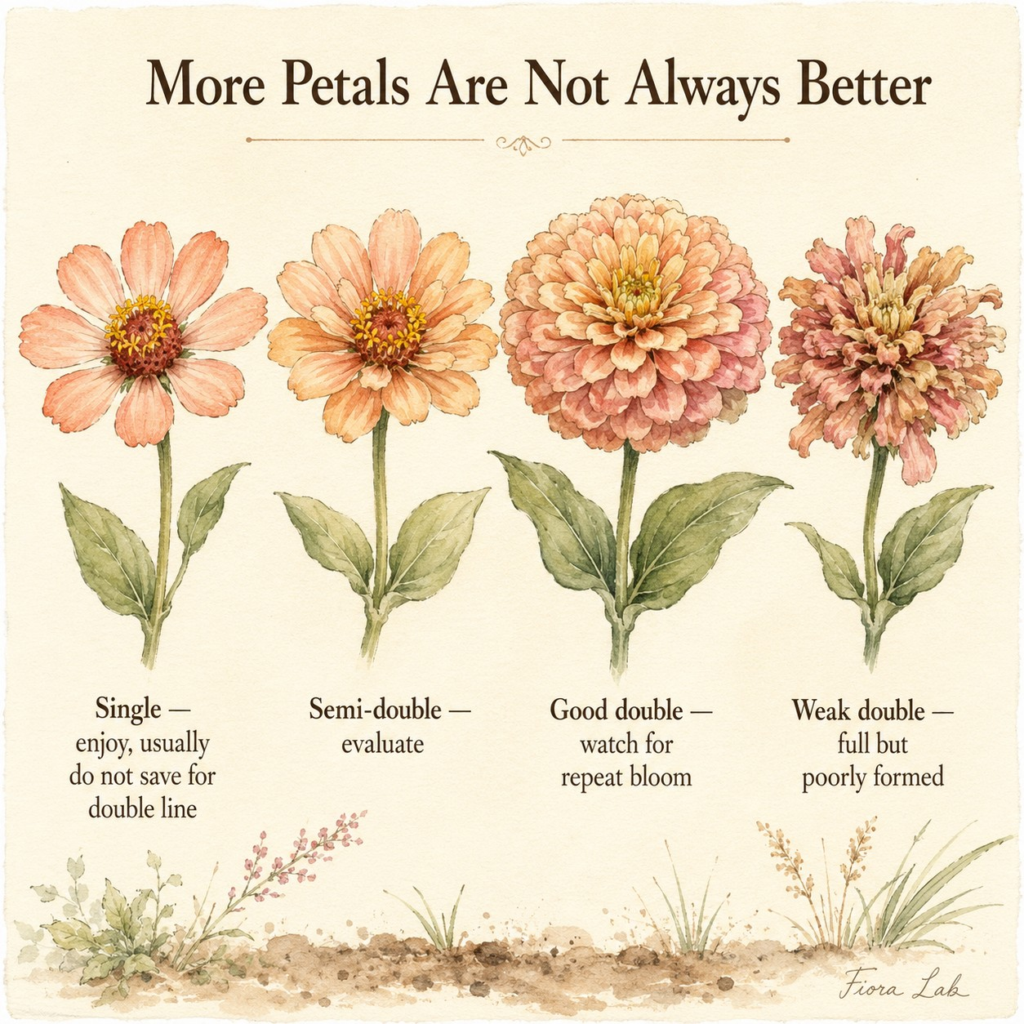
Weak doubles are the hardest category. These are flowers with extra petals but poor structure. They may be flat, messy, thin, uneven, awkward, crowded, or poorly held. They may look fuller than singles, but they may not move the project forward.
Do not save a plant only because it has more petals.
More petals are not always better. A strong semi-double with good shape may be more useful than a weak double with bad structure. A balanced bloom with moderate fullness may be better than a crowded bloom that collapses in the vase. A flower that can make seed may be more useful than an overfull bloom that looks beautiful but contributes poorly to the next generation. Fullness should serve the flower. It should not ruin it.
Many zinnias look better from the front than from the side.
For selection, look at both.
Is the flower balanced?
Is the center hidden or attractively filled?
Are the petals arranged well?
Does the bloom look intentional?
Does the flower have depth?
Is it rounded, domed, layered, or flat?
Does the bloom sit well on the stem?
Does the neck look strong enough?
A flower that looks full from the front but flat from the side may not be the best parent for a project seeking lush, dimensional blooms. Side view matters because bouquets are not flat photographs. The flower has to hold itself in space.
A double-bloom project still needs seed. Some very full flowers may produce less accessible seed. Others may produce seed, but only in certain parts of the head or only if the center remains fertile enough. A flower can be beautiful and difficult to continue.
That does not mean you should avoid full blooms. It means you should watch whether the plant can produce viable seed.A double-bloom project still needs seed. Some very full flowers may produce less accessible seed. Others may produce seed, but only in certain parts of the head or only if the center remains fertile enough. A flower can be beautiful and difficult to continue.
That does not mean you should avoid full blooms. It means you should watch whether the plant can produce viable seed.
If a plant is extraordinary but seed is sparse, save whatever you can and label the weakness honestly. It may still be worth testing. But if a plant cannot contribute seed at all, it may remain a beautiful garden memory rather than a reliable parent.
If you are serious about improving doubleness, keep special plants separate. This is especially useful when you have several different kinds of fullness. One plant may be large and dahlia-like.
Another may be rounded and pompon-like.
Another may have a raised center.
Another may be semi-double but very strong.
Another may be fully double but weak.
If you mix all the seed together immediately, you lose information. Next year, you may not know which plant produced the best family. Separate envelopes allow the garden to teach you.
“Cream double — strong stem — save separately.”
“Blush semi-double — clean foliage — maybe.”
“Rounded antique — good form — test family.”
“Full double but weak neck — separate, caution.”
Those notes help you evaluate families the next year. A single plant can be tested. A mixed envelope can only be guessed at.
If you want to improve double bloom percentage, you need enough plants to see the range. Three plants may not tell you much. Ten plants can begin the conversation. Twenty-five gives a better look. Fifty or more gives stronger selection choices.
But the right number is still the number you can actually observe.
Do not grow so many that you stop taking notes. A double-bloom project needs comparison. You need to see how many singles appear, how many semi-doubles, how many good doubles, and how many weak doubles. You need to know whether one seed family gives better form than another. You need to see whether fullness repeats across the plant.
The goal is not only to find a double flower.
The goal is to learn which plants produce better families.
These plants have good fullness, useful color, strong enough stems, and repeat bloom. Save seed for the main line.
These plants have partial fullness or one excellent trait but need caution. Save separately.
These plants may not fit the main line but have something worth testing: unusual center, rare color, strong stem, late-season health, or special form.
These plants may be pretty, but they do not move the double-bloom project forward.
This system keeps the project focused without becoming too rigid.
Do not save a plant just because one flower is full. Save from plants that repeat the kind of fullness you want and have enough strength to carry it.
That rule prevents many mistakes.
It keeps you from saving weak doubles.
It keeps you from saving every semi-double.
It keeps you from letting ordinary singles shape the line.
It keeps you focused on whole plants, not isolated blooms.
Double zinnias are not built by wishing. They are built by repeated selection pressure.
Each year, give the fuller, better plants more chances to continue.
Each year, give ordinary singles fewer chances to shape the next generation.
That is how the project moves.
Not perfectly.
Not instantly.
But in a direction.
Fiora Lab zinnia seed is early-generation selection material. That means variation is expected, including singles, semi-doubles, doubles, unusual forms, and off-types. For a double-bloom project, the gardener’s role is to grow enough plants to see variation, mark the fullest useful plants, save seed intentionally, and select again next season.
Do not expect every seedling to be double. Look for the plants that make better doubles possible.