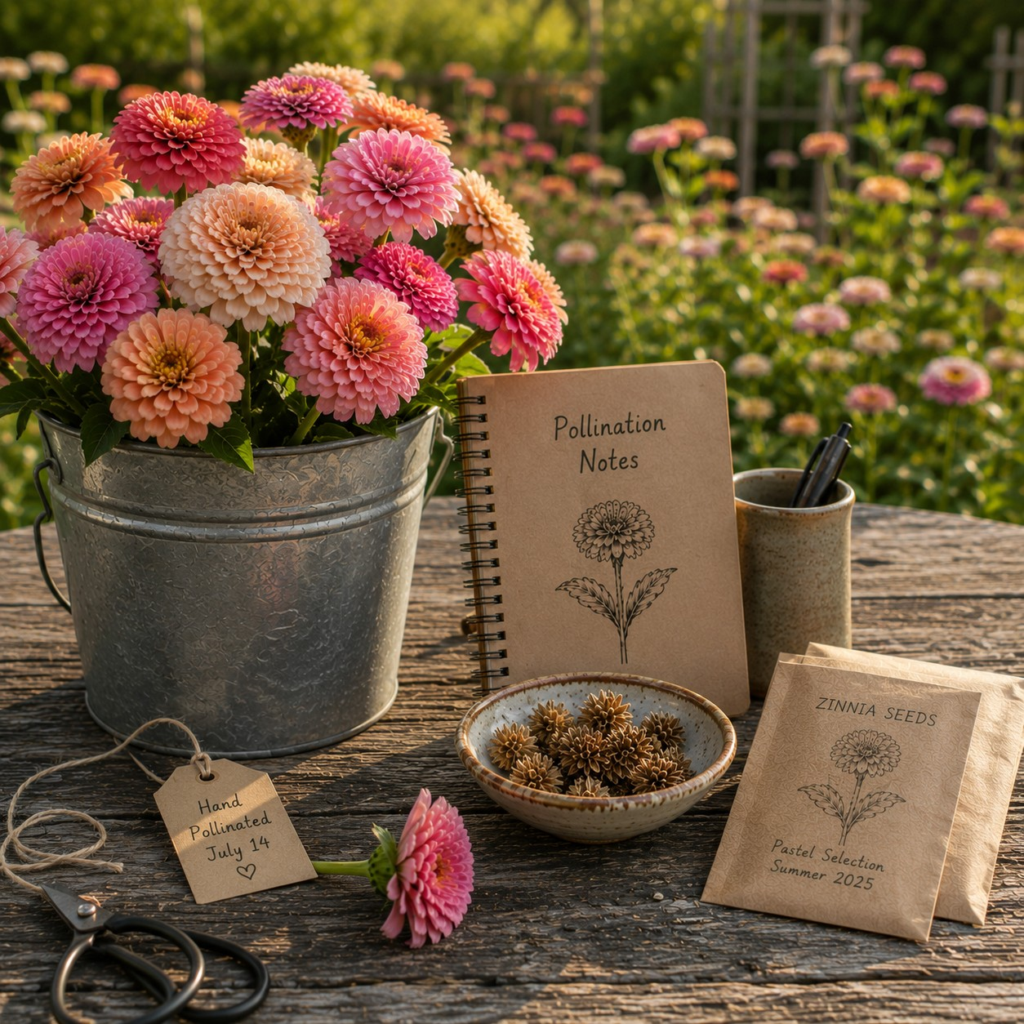
What Early-Generation Zinnia Seed Really Means
Early-generation zinnia seed is not a finished promise. It is a beginning. That is the most important thing to understand before growing a Fiora Lab-style zinnia project. Early-generation, open-pollinated seed is not the same as a uniform commercial hybrid or a finished variety that has been stabilized, produced, described, and packaged to behave within a narrow range.
It is still moving. It may produce plants that are close to the project goal. It may produce plants that are only partly there. It may produce ordinary flowers, off-types, singles, doubles, weak stems, strong stems, strange colors, beautiful surprises, and plants that do not match the picture in your mind.
That does not mean the seed failed.
It means the population is alive with possibility.
For a hobby gardener, that possibility is the point.
A finished commercial variety is supposed to be predictable.
When a seed company sells a finished variety, the gardener expects the plants to resemble the description. There may still be some natural variation, but the range should be narrow enough that the variety can be honestly named, photographed, grown, and sold.
That kind of predictability matters.
Florists need predictable colors and stems. Flower farmers need crops they can schedule. Seed companies need varieties that customers can trust. Gardeners buying a named variety expect it to behave like the description most of the time.
Early-generation seed is different.
It is not asking you to admire uniformity.
It is asking you to participate in the choosing.
A selection population has a direction, but it is not finished. It is material for observation. It gives the gardener something to grow, compare, mark, save, and improve.
When gardeners are used to uniform seed, variation can feel like a problem.
One plant is soft peach. Another is brighter coral. One is double. Another is single. One has a strong stem. Another bends after rain. One bloom looks close to the dream. Another looks ordinary.
It is tempting to think something went wrong.
But in early-generation selection work, variation is expected.
Variation is what gives the gardener choices.
Without variation, there is nothing to select. You cannot choose softer color if every flower is the same. You cannot select stronger stems if no plants differ in stem strength. You cannot improve late-season performance if every plant responds identically to heat, humidity, and disease pressure.
The row may look uneven.
That unevenness is information.
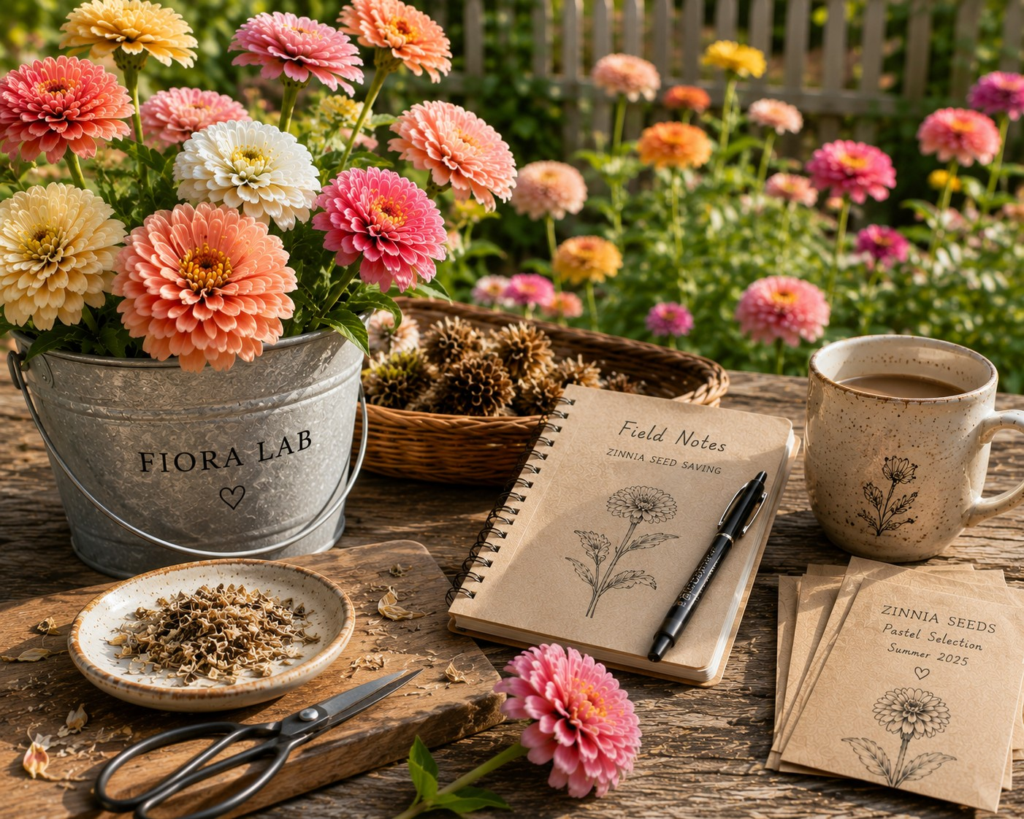
An early-generation seed line should still have a direction. It should not be random.
For example, a pastel zinnia selection population might be moving toward cream, blush, peach, champagne, oatmeal, antique rose, warm ivory, soft apricot, and other florist-friendly tones. A double-bloom project might be moving toward fuller flowers. An August Survivor project might be moving toward plants that still look useful when summer becomes difficult.
But moving toward a goal is not the same as arriving there.
In the beginning, direction matters more than uniformity.
A gardener may find only a few plants that truly fit the dream in the first season. Those plants matter. They become the starting points. The next year, the gardener grows from them and asks what came back. Some traits may return. Some may disappear. Some may improve. Some may surprise you.
That is not failure.
That is the work.
A finished seed packet is often treated like the final answer.
An early-generation seed packet should be treated like the first question.
The packet does not finish the project for you. It starts the conversation. The garden continues it.
Early-generation seed must be described honestly.
It should not be sold or presented as if every seed will produce the dream flower. That creates the wrong expectation and makes natural variation feel like disappointment.
This is an early-generation, open-pollinated selection population.
Variation is expected.
Some plants may be close to the project goal.
Some may be ordinary.
Some may surprise you.
Save seed from the plants that deserve another season.
That language does not weaken the seed.
It builds trust.
It tells the gardener what kind of experience they are entering. They are not buying identical flowers. They are growing a population with a direction.
Open-pollinated seed can sometimes be misunderstood.
It does not mean careless seed.
It means pollination was not controlled in the way a hand cross, isolation cage, or hybrid seed production system would be controlled. Bees and other insects may move pollen between flowers. The gardener may know the mother plant but not always the pollen parent.
That looseness creates variation.
But selection can still be intentional.
A grower can choose which mother plants are allowed to produce seed. They can remove plants that clearly do not belong. They can group similar projects together. They can keep rare plants separate. They can save seed only from plants that move the line forward.
Open-pollinated does not mean random if the gardener is selecting.
It means the project is shaped by both pollinators and human choices.
The bees create possibilities.
The gardener decides which possibilities continue.
A grower should expect a range.
Singles.
Semi-doubles.
Doubles.
Rounded blooms.
Flat blooms.
Raised centers.
Messy doubles.
Strong forms in the wrong color.
Beautiful forms on weak plants.
Plants that mildew early.
Plants that keep growing.
Plants with strong stems.
Plants that flop.
Plants that bloom generously.
Plants that quit too soon.
That range is not the enemy.
It is the material.
Early-generation seed should be grown with enough space and attention to evaluate individual plants.
That does not mean you need a field. A small garden can still teach you a lot. Ten plants can begin the project. Twenty-five gives more comparison. Fifty gives better choices. One hundred creates a stronger selection population.
But the right number is the number you can actually watch.
If you grow too many plants and stop taking notes, the project becomes less useful. A smaller planting observed carefully is better than a large planting ignored.
Give plants enough room to show their habit. Label the row. Photograph standouts. Mark possible keepers while they are still alive. Watch more than the first bloom. Notice whether the plant holds up after cutting, rain, heat, humidity, and disease pressure.
Early-generation seed gives you variation.
Your job is to see it clearly.
Do not save seed from everything.
That is the fastest way to keep the population scattered.
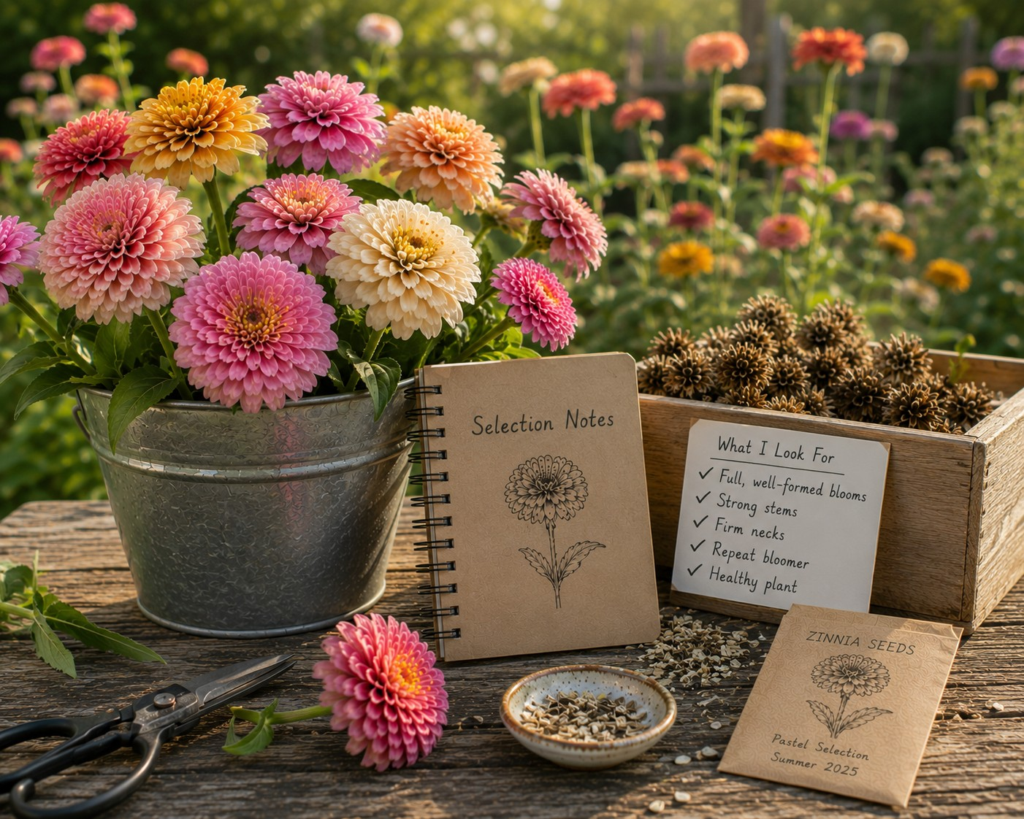
If the project is pastel color, save from the softest useful plants.
If the project is fuller blooms, save from the fuller useful plants.
If the project is stronger stems, save from the plants that actually hold their flowers.
If the project is August survival, save from plants that are still alive, productive, and worth looking at when the row is tired.
Use a main envelope for the plants that clearly fit the project direction.
Use separate envelopes for rare or interesting plants that should not yet enter the main line.
For example:
“Main Pastel — best cream, blush, peach.”
“Purple Edge — save separately.”
“Strong Stem — brighter color, possible future use.”
“Scabiosa Center — wrong shade, test family.”
“August Survivor — ordinary bloom, strong plant.”
Separate envelopes protect information.
A mixed envelope can be useful when several plants fit the same direction. But mixing everything too soon makes it harder to learn which plant contributed what.
This is where Fiora Lab seed is different from a normal packet of flowers.
A finished seed packet asks the gardener to grow and enjoy.
An early-generation selection packet asks the gardener to grow, observe, and participate.
That does not mean every customer has to become a serious breeder. A gardener can simply grow the flowers and enjoy the variation. That is still valid.
But the invitation is there.
Mark the plant that makes you stop.
Save seed from the one that holds up.
Notice which flowers fit your palette.
Send notes or photos.
Return seed if the project includes a seed-return program.
Grow the next generation if you want to keep going.
The gardener is not only a buyer.
The gardener becomes another set of eyes in the population.
The wrong expectation creates disappointment.
The right expectation creates curiosity.
“Every seed should produce the exact flower in my mind.”
“This packet gives me a population moving in a direction. My job is to find the best plants in my garden and decide what deserves another season.”
“Variation means the line is bad.”
“Variation gives me something to select from.”
“One beautiful bloom should become uniform next year.”
“One beautiful bloom may become a family worth testing.”
This is the emotional difference between shopping for a finished product and participating in a living project.
Those promises would not be honest. Instead, early-generation seed can honestly promise a direction, a selection history, and a chance to participate.
This population has been selected toward a goal.
It still contains variation.
Grow enough plants to see the range.
Save from the best.
Expect surprises.
That is a stronger kind of honesty.
Early-generation seed is exciting because the story is not finished.
A finished variety gives beauty.
An early selection population gives beauty plus discovery.
You may grow a plant no one else has seen in quite the same way. You may find a color worth saving separately. You may see a form that deserves another season. You may discover that one seed family performs better in your heat, your humidity, your soil, your backyard.
The project becomes personal.
The flower is not only something you bought.
It is something you watched, selected, saved, and carried forward.
That is why early-generation seed can be meaningful for hobby gardeners. It gives the gardener a role.
Do not expect uniformity. Look for direction.
The question is not whether every plant matches.
The question is whether the population gives you something worth choosing from.
If it does, the project is alive.
Grow it. Observe it. Mark what matters. Save only what deserves another season. Replant with curiosity.
That is what early-generation zinnia seed really means.
Fiora Lab zinnia seed packets are early-generation, open-pollinated selection populations. They are not finished commercial hybrids or fully stabilized varieties. Variation is expected.
Grow the seeds. Observe the plants. Mark the standouts. Save seed from the plants that move the project forward. The goal is not identical flowers from every seed. The goal is a living population worth watching.