Why Saved Zinnia Seed Does Not Always Match the Parent
One of the first surprises in zinnia seed saving is this: the seed you save from a beautiful flower may not grow into that exact flower again.
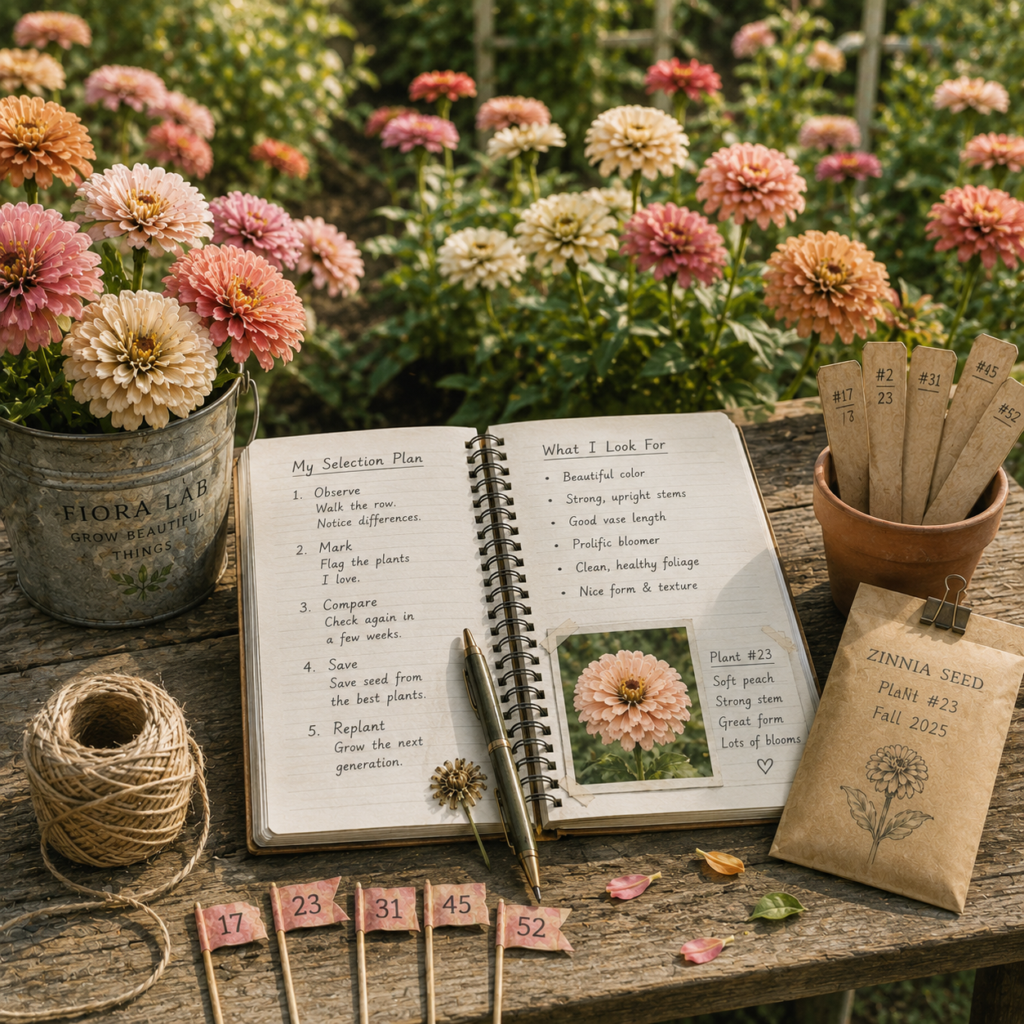
That can feel disappointing at first. You marked the plant. You waited for the seed head to dry. You saved the seed carefully. You labeled the envelope with hope. Then the next season comes, and the seedlings do not all look like the flower that made you stop.
This is not necessarily a mistake. It is how seed works.
A cutting is a copy. A seed is a new combination. That difference is the beginning of honest backyard zinnia selection.
When you save seed from a zinnia, you are not placing the exact flower into an envelope. You are saving a possibility.
That seed carries the contribution of the plant that made the seed head. It may also carry pollen from another plant nearby. It may carry hidden traits that did not show clearly in the parent bloom. It may express color, form, stem strength, doubleness, or plant habit differently in the next generation.
This is why a soft pastel zinnia can produce seedlings with stronger colors. It is why a double bloom can produce singles and semi-doubles. It is why a cream flower with a purple edge may not give you a whole row of cream flowers with purple edges.
The flower you loved was real. The seed you saved is real. But the seed is not a guarantee that the next generation will repeat the parent exactly. It is a question for the next season.
When you save zinnia seed, the mother plant is the plant that produced the seed head. That part of the story is known.
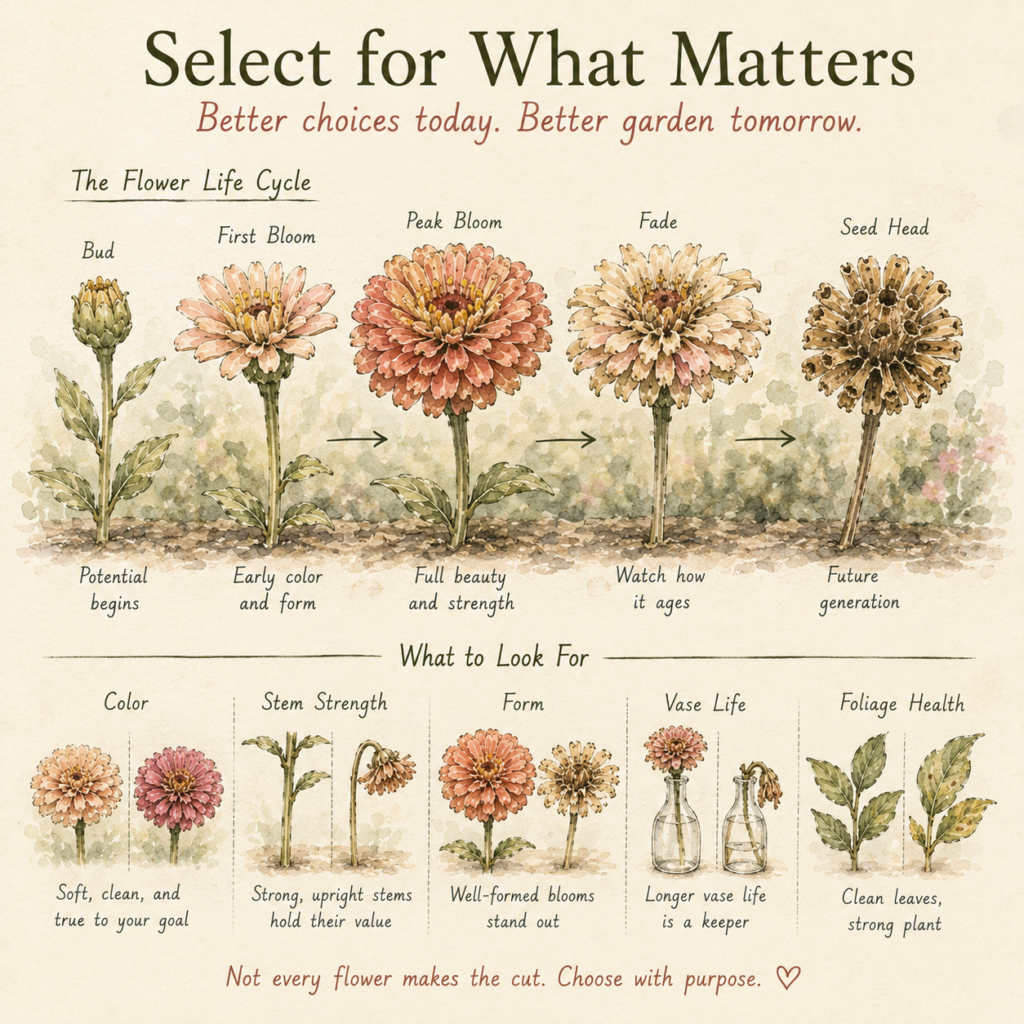
You can see the mother plant’s bloom color, flower form, stem strength, foliage health, branching, height, productivity, and late-season performance. You can decide whether that plant deserves to shape the next generation.
This is why careful selection still matters, even with open-pollinated seed.
Do not save seed from a weak, diseased, off-color plant just because the seed head is dry and easy to collect. Do not save from a plant with poor stems and poor foliage only because it happened to make seed.
The mother plant is not the whole story, but it is a real part of the story. Choose it with intention. A strong mother plant gives the next generation a better starting question than a plant you did not really want.
The pollen parent is the plant that contributed pollen. In a controlled cross, the gardener chooses the pollen parent. In most backyard zinnia projects, the pollen parent is usually unknown.
That is because zinnias are visited by bees and other insects. A bee may move from a red zinnia to a peach zinnia, from a cactus-form flower to a scabiosa-type flower, from a bright bloom to the soft pastel flower you marked as special.
When you save seed from your marked plant, you know the mother plant. But unless you controlled the pollination, you usually do not know which plant provided the pollen.
This is why open-pollinated zinnia seed can surprise you. It may carry the direction you wanted. It may also carry influence from the rest of the row. That uncertainty is not a reason to give up. It is a reason to label honestly.
Open pollination means insects move pollen naturally, without the gardener controlling every cross. For a hobby gardener, open pollination is often the easiest and most practical way to begin.
It does not require pollination cages, hand crosses, isolation blocks, or technical equipment. You grow a population, observe the plants, mark the best ones, save seed from selected mothers, and grow the next generation.
This is not perfect control. But it is still selection.
The bees create variation. The gardener decides which seed heads are worth saving. That means you can still move a population in a direction. If you repeatedly save seed from softer colors, stronger stems, fuller blooms, cleaner foliage, and better late-season plants, your choices begin to matter over time.
Not instantly. Not perfectly. But gradually.
Saved zinnia seed may vary for several reasons. The pollen may have come from another plant. The mother plant may carry hidden traits. The seed lot may still be unstable. Color may be influenced by several factors. Flower form may not repeat cleanly. Weather, soil, spacing, fertility, and disease pressure may also affect how the plant performs.
A parent bloom may look finished in your hand while the genetics behind it are still mixed. That is especially true in early-generation selection work.
A finished commercial variety is expected to behave within a narrower range. An early-generation or open-pollinated selection population is still moving. Some plants may match the project goal. Some may partially match. Some may be ordinary. Some may reveal a surprise worth following.
That variation can be frustrating when you expected uniformity. But for a backyard selector, variation is also the material you work with. Without variation, there is nothing to select.
Color is one of the first traits gardeners notice, but it is not always simple. You may save seed from a soft peach flower and see peach, cream, coral, rose, yellow, or stronger colors the next year. You may save from a pale bloom and still get bright seedlings. You may save from a bicolor or edged flower and find that the pattern disappears, changes, or appears in only a few plants.
This does not mean the seed was bad. It means color can be complex.
Soft colors are often delicate because they may depend on reduced intensity, undertones, fading behavior, or combinations that are easy to lose. A pastel project therefore needs repeated selection pressure.
If you want blush, cream, champagne, oatmeal, antique rose, pale peach, warm ivory, or soft apricot, those plants need to get more votes than the bright ones.
A bright flower can still be beautiful. It may even carry strong form or vigor. But if it does not belong in the main pastel project, save it separately or enjoy it without letting it shape the main line.
Double blooms can also disappoint beginners because they do not always come back exactly as expected. A fully double zinnia may produce double offspring, but it may also produce semi-doubles and singles. That is especially true if the population is still variable or the pollen parent is unknown.
The honest way to think about double blooms is this:
Double parents may improve your odds of seeing double offspring, especially when the population already carries doubleness, but they do not guarantee that every seedling will be double.
This is why the work takes more than one season. You save from the fullest plants that also have useful color, stems, health, and productivity. You avoid saving broadly from ordinary singles if your goal is more doubles. You grow the next generation and choose again.
The goal is not to make every seedling perfect. The goal is to give yourself better choices.
One of the best habits in backyard zinnia selection is keeping special plants separate. This means one selected plant gets its own envelope.
Not every plant needs this treatment. But a rare or important plant should not disappear into a mixed seed lot too quickly.
Save separately when you find:
Separate envelopes help you learn faster. If one cream double plant produces many good seedlings and another produces mostly weak singles, you will know because you kept the families separate. If one purple-edged plant gives you nothing useful and another produces several interesting seedlings, you will know.
If you mix everything immediately, you may still get variation, but you lose information. Separate envelopes slow you down in a good way. They let the garden teach you with more detail.
There is still a place for mixed seed.
If several plants clearly match the same project direction, a group envelope can make sense. This is a simple form of mass selection. You might save from five strong pastel plants with good stems and combine them as the main line for next year.
The key is to mix intentionally. Do not mix seed because you forgot where it came from. Mix because several plants met the goal and deserve to shape the next generation together.
A group envelope says: these plants all deserve a vote. An individual envelope says: this plant deserves to be tested on its own. Both methods are useful.
A simple way to stay honest is to write three expectations on your seed envelope or in your notebook.
01
02
03
What should you not promise?
For example, if you save seed from a cream flower with a purple edge growing near many bright zinnias, you might write:
This keeps hope alive without turning hope into a false promise. A gardener can love a rare flower and still describe the seed honestly.
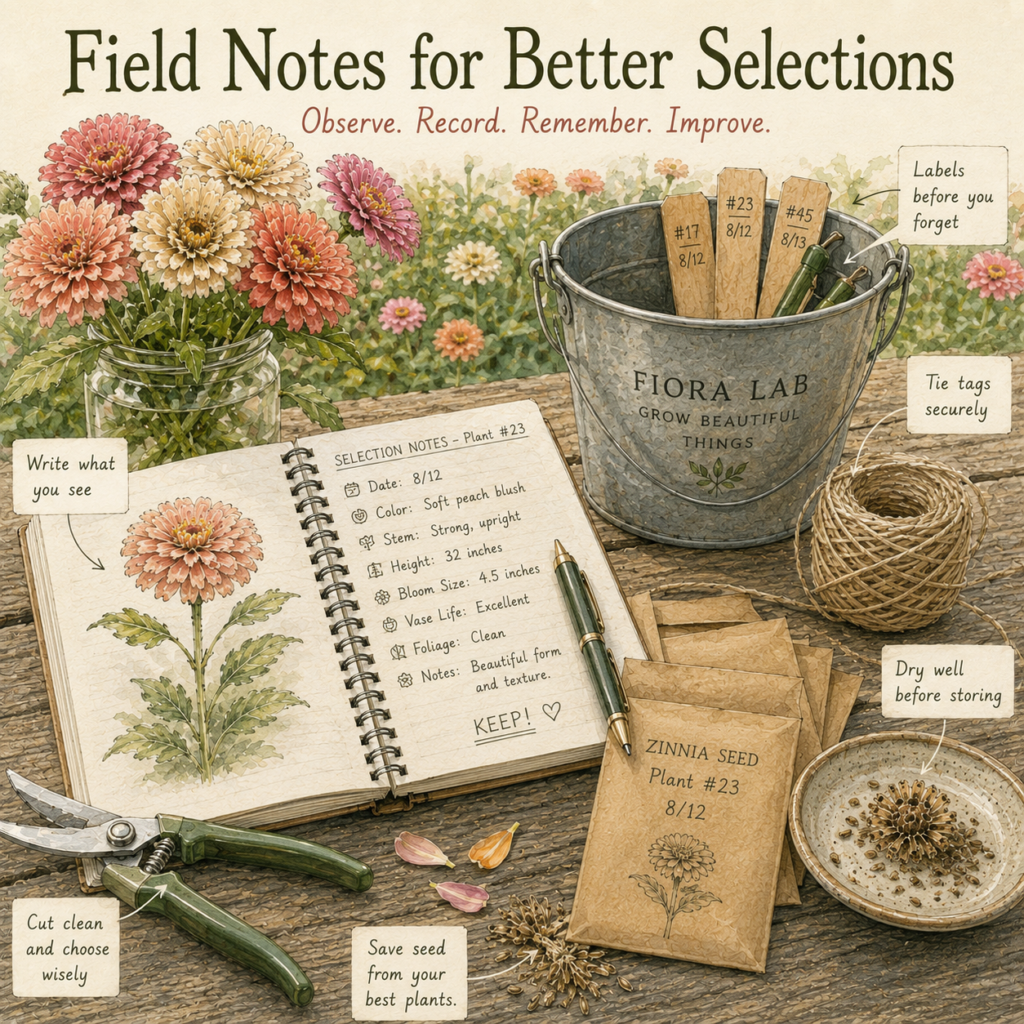
Early-generation zinnia seed should not be described like a finished uniform variety. It should be described as a living selection population.
That means variation is expected. Some plants may be close to the project goal. Some may be ordinary. Some may be surprising. A few may be worth saving from.
For Fiora Lab, this honesty is part of the invitation. You are not buying a row of identical flowers. You are growing a population with a direction.
The packet begins the project. The garden continues it.
Saved zinnia seed does not always match the parent because seed is not a copy. It is a possibility.
The mother plant matters. The pollen parent may be unknown. Color is complex. Double blooms take repeated selection. Early-generation populations vary because they are unfinished. Open pollination creates surprises, and those surprises are part of the work.
The next generation may not give you exactly what you hoped for. But it will give you information. And if you keep watching, choosing, labeling, saving, and replanting, the population begins to carry your eye forward.
That is backyard selection. Not a promise. A practice.
Save seed from the plants that deserve another season. Keep rare plants separate. Let the next generation show you what returned.