Why Zinnias Are Perfect for Backyard Selection
Zinnias are one of the best flowers for a hobby gardener who wants to begin saving seed with more intention. They are generous, fast, colorful, and forgiving. They do not make you wait years before they show you something useful.
You can plant seed in spring, see flowers by summer, make selections while the plants are still blooming, save seed by fall, and grow the next generation the following year.
For a backyard gardener, that matters. Some plants require years of patience before they reveal much. Some need special storage, expensive stock, overwintering space, greenhouse conditions, or more technical knowledge than most gardeners want to manage in the middle of ordinary life. Zinnias are different. They let you begin before you feel fully ready.
You do not need acres. You do not need a greenhouse. You do not need to understand every genetic detail behind color, doubleness, disease tolerance, or flower form before planting your first row.
You need seed, sun, labels, curiosity, and enough discipline not to save seed from every pretty flower.That is where backyard selection begins.
Backyard selection depends on visible differences. You cannot select what you cannot see.
This is where zinnias become such good teachers. A single row can show you short plants and tall plants, single blooms and double blooms, strong stems and floppy stems, soft colors and harsh colors, clean foliage and early mildew. One plant may branch beautifully. Another may stay stiff and narrow. One may produce long stems that belong in a vase. Another may make a charming flower on a stem too short to cut.
At first, most gardeners notice color. That is natural. A soft peach bloom, an ivory flower with a blush edge, or a dusty rose zinnia can stop you immediately.
But once you begin selecting, you start seeing more. You notice the stem under the bloom. You notice whether the neck is strong or weak. You notice whether the plant keeps producing after cutting. You notice whether the leaves stay reasonably clean when the weather turns humid. You notice whether the flower fades beautifully or becomes muddy. You notice whether the plant still deserves attention in August.
That is the first lesson zinnias teach: you are not only growing blooms.
Zinnias are beginner-friendly, but they are not boring.
They germinate easily in warm soil, grow quickly, and bloom generously. They can fit into a raised bed, vegetable garden edge, cutting patch, backyard row, or even a small trial space. A gardener can start with ten plants and still learn something. Twenty-five plants give more comparison. Fifty plants give better choices. One hundred plants create a stronger selection project.
But the best number is not the biggest number. The best number is the number you can actually watch. A small zinnia patch observed carefully is more useful than a large planting ignored. Backyard selection is not only about growing more plants. It is about paying better attention.
That is why zinnias work so well for hobby gardeners. They allow the project to begin at human scale. One packet. One row. One notebook. One marked plant. One seed envelope labeled before the details are forgotten.
A project does not need to be large to be meaningful. It needs to be clear.
The word “breeding” can sound intimidating. It can make a simple garden project feel like it belongs only to professionals with greenhouses, isolation cages, pollen brushes, and rows of trial plants. Those tools have their place. Professional breeders use them for good reasons. But the first breeding skill is much simpler.]
Selection means deciding which plants are allowed to contribute seed to the next generation. That may sound small, but it is one of the oldest ways people have shaped plants. Gardeners and farmers have always saved seed from plants that tasted better, survived better, bloomed better, held up longer, or carried some quality worth seeing again.
A professional breeder may work with controlled crosses, large populations, detailed records, and multiple years of trialing. A backyard gardener works more simply. You may grow one row of zinnias, mark five plants, save seed from three, and replant those seeds next year.
The scale is smaller, but the principle is real. You are saying: more of this, less of that. That is the beginning of a breeding project.
Most backyard zinnia projects begin with open pollination. That means bees and other insects move pollen from flower to flower without the gardener controlling every cross.
For a beginner, this is not a failure of the system. It is the system.
A bee may visit a cream flower, then a peach flower, then a red flower, then the pastel bloom you marked as special. When you save seed from that marked plant, you know the mother plant. You know the plant that carried and matured the seed. But unless you controlled pollination, you usually do not know the pollen parent.
That uncertainty is one reason saved zinnia seed can surprise you. It is also part of the pleasure.
Open pollination creates variation. The bees create possibilities. The gardener decides which possibilities continue. You do not have to control every cross to begin moving a population in a direction. You can still be intentional. You can group similar projects together, remove plants that clearly do not belong, mark the best mother plants, save special plants separately, and grow the next generation with better questions.
Backyard selection does not require perfect control from the start.
It requires more intention than last year.
Most of us begin by wanting to save seed from the prettiest flower. That is understandable. Beauty catches the eye first.
But pretty is not always enough. A flower can be beautiful on a weak stem. It can have perfect color on a plant that mildews early. It can be fully double but unproductive. It can be large but floppy. It can look wonderful in June and disappointing by August.
This does not mean beauty stops mattering. It means beauty has to prove itself.
A good seed parent should be more than one beautiful bloom. It should be a plant worth continuing. Look at the flower, but also look at the stem, neck, branching, foliage, productivity, health, and late-season performance.
This is the shift from casual seed saving to selection.
A casual grower asks, “Which flower do I like?”
A backyard selector asks, “Which plant deserves another season?”
That question changes everything.
You are learning what your seed can do in your garden. Which colors appear? Which forms are common? Which plants are vigorous? Which stems are useful? Which flowers fade well? Which plants keep blooming after heat, humidity, rain, pests, and disease pressure begin testing the row?
A catalog photo can tell you what a flower is supposed to be. Your garden tells you what it actually does.
That is why the first year should be approached with curiosity instead of pressure. You may find one remarkable plant. You may find several maybes. You may find that your starting seed does not move in the direction you hoped. All of that is information.
The goal is not perfection.
The goal is to see clearly enough to choose better next time.
Do not make your first zinnia selection system too complicated.
Use three categories: Yes, Maybe, and No.
01
A Yes plant clearly matches the direction of the project. It should be marked, photographed, watched, and considered for seed.
02
A Maybe plant has one strong trait but needs more observation. It may have beautiful color but weak stems, strong stems but ordinary color, or an unusual form that deserves a separate envelope.
03
A No plant may still be beautiful, useful, cheerful, or worth cutting for bouquets. It simply should not shape this project.
That distinction matters. You can enjoy a flower without saving seed from it. Cut the bright ones. Photograph the strange ones. Give away the cheerful ones. Let the bees have the singles. But when it comes time to save seed, become more selective.
Seed saving is not only preservation. It is a vote for the future of the population.
Before the first bloom opens, decide what you are trying to select for. Not five things. One main direction.
You might choose softer pastel color. You might choose rounded pompon form. You might choose stronger stems. You might choose fuller double blooms. You might choose plants that still look good in August. You might choose unusual forms worth saving separately.
You can care about many traits, but the project needs a priority.
Without a priority, every plant becomes confusing. One has the right color but weak stems. Another has excellent stems but the wrong color. Another has a beautiful flower but poor foliage. Another is healthy but ordinary.
The project direction helps you decide.
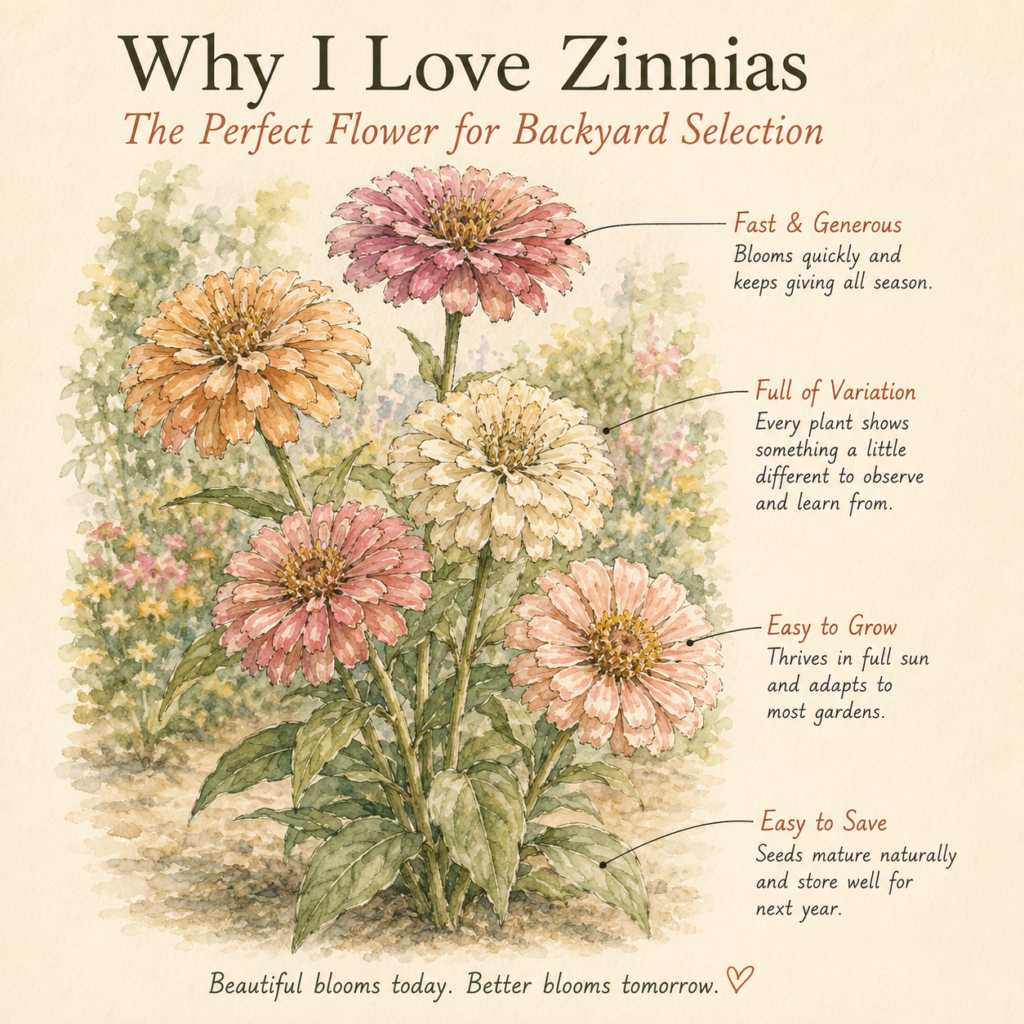
Fiora Lab’s zinnia work is built around this idea: a flower population does not have to be finished to be worth growing.
Early-generation, open-pollinated zinnia seed is not the same as a uniform commercial hybrid. It may produce variation. Some plants may be close to the project goal. Some may be ordinary. Some may surprise you. A few may be worth saving from.
That is not a flaw in the project.
A finished variety asks you to admire uniformity. A living selection population invites you to participate in the choosing.
For the hobby gardener, that can be more meaningful than growing a row where every plant is already decided. The garden becomes a place of observation, not just display. You are not only asking, “Did this bloom?”
You are asking, “What came back? What improved? What disappeared? What deserves another season?”
Backyard zinnia selection does not begin with perfect knowledge. It begins when one plant makes you stop.
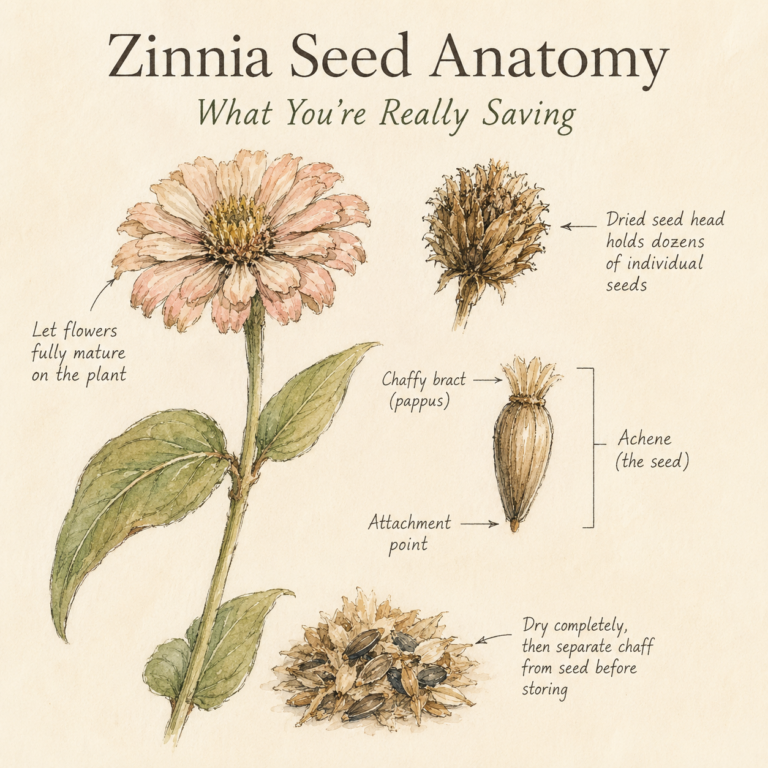
You mark it. You photograph it. You watch it again later. You decide whether the plant still deserves attention after the first excitement fades. If it does, you let at least one seed head mature. You dry it, save it, label it, and give the next season a question to answer.
That seed is not a guarantee.
It is a possibility.
And for a hobby gardener, possibility is enough reason to begin.
That is the simple method. One season will not give you a finished zinnia. But it can give you a better eye, a better question, and one envelope of seed labeled with hope:
Fiora Lab seed packets are early-generation, open-pollinated zinnia selection populations for gardeners who want to grow softer, more romantic, florist-style zinnias while participating in the selection process.
Grow the seeds. Observe the plants. Mark the standouts. Save seed from the plants that deserve another season.
The goal is not to grow identical flowers from every seed. The goal is to grow a population worth watching.