
My Real Weekend Flower Farming Calendar (Zone 8)

By fioralab

April 28, 2026

Share

Contents

This is my real working calendar based on Year 1 results — not theory. It’s built for a weekend workflow and focuses on repeatable systems instead of guesswork.

My Real Weekend Flower Farming Calendar (Zone 8)

20 Plants. 4 Seasons. Built for Real Life (Not Theory)


This is not a theoretical planting guide. This is my actual working calendar after Year 1—built around weekends, real failures, and what actually produced flowers. I stopped trying to grow everything and narrowed it down to 20 core plants that give me flowers for arrangements across all four seasons.


The biggest shift? I stopped asking “what should I grow?” and started focusing on “when should I plant?”


👉 If you want to understand how I built this system from scratch, read this first:


→ Seed Starting System: What Actually Works (Skip the $400 Mistakes)

This Is My Real Working Calendar — Not Theory

I built this system around one constraint: I only have weekends to garden. Everything here is designed to be repeatable, low decision fatigue, and based on timing—not guesswork.


👉 This calendar only works because I simplified my growing system:
→ Growing and Harvesting (What Actually Worked & What Didn’t)

1-Minute Summary (Start Here)

What changed everything:

What actually matters:


✔ Timing > variety
✔ Airflow > everything
✔ Fewer crops = better results

My 20 Plant System (What I Actually Grow)

This is the exact mix I rely on for year-round flower arranging.
Focal Flowers (5)
Supporting + Accent Flowers (6)
Foliage + Structure (4)
Line + Specialty Flowers (5)

👉 This system feeds directly into my arrangement workflow:

→ Floral Arrangement Setup: Real Cost, Tools & Workflow

Critical Correction (Zone 8 Reality)

I do NOT plant ranunculus in October.


What actually works:

👉 This one correction alone fixed my spring season.

My Real Weekend Planting Calendar

Everything below is based strictly on Saturday–Sunday execution.
MAY 2026
👉 Plant mums from King’s Mums.
JUNE 2026
JULY 2026
AUGUST 2026
SEPTEMBER 2026
OCTOBER 2026

Ordering Shortcut: Farmer Bailey “Farmer’s Dozen”

October is when I decide if I want to simplify spring.


Ordering this gives me plugs in March, replacing multiple crops temporarily.


👉 Helpful shortcut—but not my core system.

NOVEMBER 2026
DECEMBER 2026

December 19–20 — Order lisianthus


Minimal work
Monitor drainage + plant survival
👉 Hellebores may bloom

JANUARY 2027 (CRITICAL WINDOW)

👉 This is when my spring actually starts

FEBRUARY 2027
MARCH 2027
APRIL 2027

What Actually Matters (After Year 1)

Final Thought

I stopped experimenting… and started running a system.


✔ Based on real failures
✔ Correct timing
✔ Built for weekends
✔ Repeatable


👉 If you feel overwhelmed, don’t add more flowers.
From the same field journal

🌸 My Real Weekend Flower Farming Calendar (Zone 8)

20 Plants. 4 Seasons. Built for Real Life (Not Theory)

This is not a theoretical planting guide. This is my actual working calendar after Year 1—built around weekends, real failures, and what actually produced flowers. I stopped trying to grow everything and narrowed it down to 20 core plants that give me flowers for arrangements across all four seasons.

The biggest shift? I stopped asking “what should I grow?” and started focusing on “when should I plant?”

👉 If you want to understand how I built this system from scratch, read this first:
Seed Starting System: What Actually Works (Skip the $400 Mistakes)


🌱 This Is My Real Working Calendar — Not Theory

I built this system around one constraint: I only have weekends to garden. Everything here is designed to be repeatable, low decision fatigue, and based on timing—not guesswork.

👉 This calendar only works because I simplified my growing system:
Growing and Harvesting (What Actually Worked & What Didn’t)


⚡ 1-Minute Summary (Start Here)

What changed everything:

  • I stopped trying to grow everything
  • I focused on timing instead of products
  • I built everything around weekends

What actually matters:
✔ Timing > variety
✔ Airflow > everything
✔ Fewer crops = better results


🌸 My 20 Plant System (What I Actually Grow)

This is the exact mix I rely on for year-round flower arranging.

🌸 Focal Flowers (5)

Ranunculus (spring)
Peonies (late spring, perennial)
Dahlias (summer–fall)
Mums (fall)
Hellebores (winter, perennial)

🌿 Supporting + Accent Flowers (6)

Zinnias (summer–fall)
Orlaya (spring)
Bells of Ireland (spring)
Gomphrena (summer)
Ageratum (spring–summer)
Scabiosa (spring–fall)

🌱 Foliage + Structure (4)

Ninebark
Viburnum
Jasmine
Eucalyptus

🌼 Line + Specialty Flowers (5)

Snapdragons
Delphinium
Lisianthus
Sunflowers
Celosia

👉 This system feeds directly into my arrangement workflow:
→ Floral Arrangement Setup: Real Cost, Tools & Workflow


⚠️ Critical Correction (Zone 8 Reality)

I do NOT plant ranunculus in October.

What actually works:

  • January (weekend): start in trays
  • March (weekend): plant out
  • April: bloom

👉 This one correction alone fixed my spring season.


🌼 My Real Weekend Planting Calendar

Everything below is based strictly on Saturday–Sunday execution.


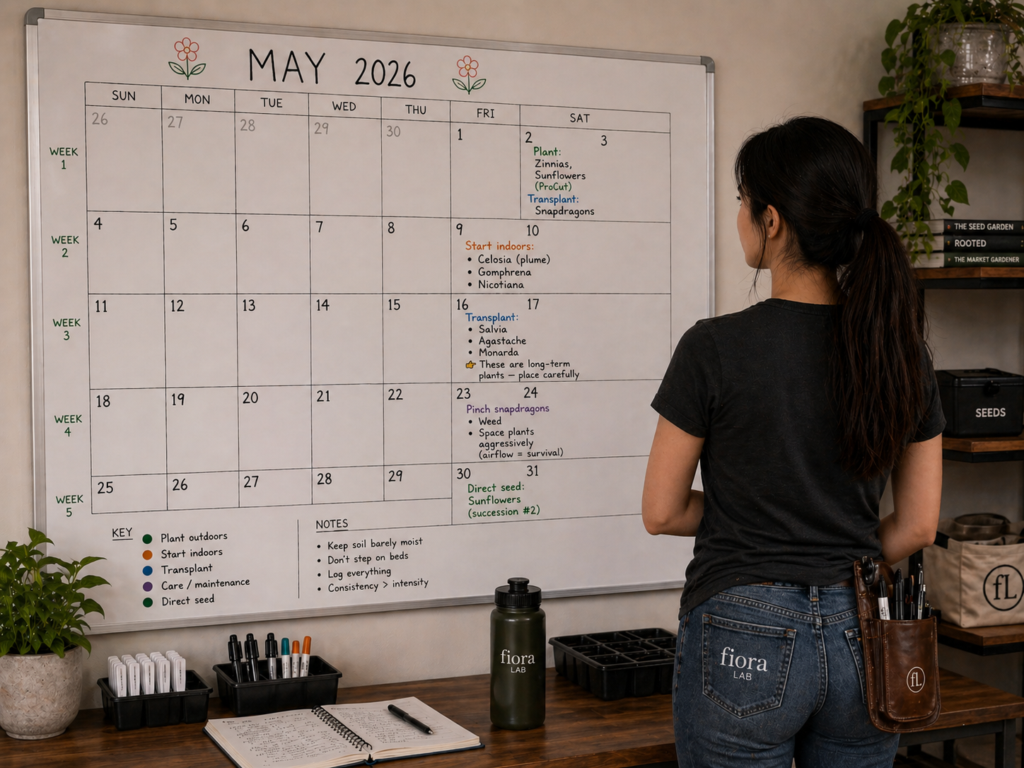
🌼 MAY 2026

May 2–3 — Plant zinnias, sunflowers. Transplant snapdragons.
May 9–10 — Start celosia, gomphrena.
May 23–24 — Pinch snapdragons, space aggressively.
May 30–31 — Direct sow sunflowers (succession), 👉 Plant mums from King’s Mums.


🌼 JUNE 2026

June 6–7 — Start lisianthus (timing practice), Start Precious Dahlia First Generation Seed Project.

June 13–14 — Harvest begins (snapdragons, delphinium).
June 20–21 — Stake dahlias, check airflow.
June 27–28 —Start Antique Pompon Zinnia project.


🌼 JULY 2026

July 4–5 — Harvest zinnias, sunflowers.
July 11–12 — Transplant celosia, gomphrena.
July 18–19 — Deadhead zinnias, support dahlias.
July 25–26 — Harvest continues.


🌼 AUGUST 2026

August 1–2 — Peak production.
August 15–16 — Prep fall beds.
August 22–23 — Order seeds.
August 29–30 — Prep trays + airflow system.


🌼 SEPTEMBER 2026

September 5–6 — Start snapdragons.
September 12–13 — Start scabiosa, delphinium.
September 19–20 — Thin seedlings.
September 26–27 — Continue cool flowers (snapdragons, delphinium, bells of Ireland).


🌼 OCTOBER 2026

October 3–4 — Transplant cool-season flowers.
October 10–11 — 👉 I do NOT plant ranunculus here.
October 17–18 — Harvest dahlias; mums begin.
October 24–25 — Maintain drainage.


🌿 Ordering Shortcut: Farmer Bailey “Farmer’s Dozen”

October is when I decide if I want to simplify spring.

Ordering this gives me plugs in March, replacing multiple crops temporarily.

👉 Helpful shortcut—but not my core system.


🌼 NOVEMBER 2026

Dig/store dahlias (optional)
Maintain cool-season flowers
Plan next season


🌼 DECEMBER 2026

December 19–20 — Order lisianthus

Minimal work
Monitor drainage + plant survival
👉 Hellebores may bloom


🌼 JANUARY 2027 (CRITICAL WINDOW)

January 9–10 — Start ranunculus + lisianthus

👉 This is when my spring actually starts


🌼 FEBRUARY 2027

February 27–28 — Start zinnias, scabiosa


🌼 MARCH 2027

March 13–14 — Plant ranunculus + lisianthus


🌼 APRIL 2027

April 17–18 — Ranunculus bloom window; plant dahlia tubers.


🔑 What Actually Matters (After Year 1)

Perennials = infrastructure
High-skill crops = ranunculus, lisianthus, delphinium
Airflow matters more than fertilizer
Spacing is not optional


🔥 Final Thought

I stopped experimenting… and started running a system.

✔ Based on real failures
✔ Correct timing
✔ Built for weekends
✔ Repeatable

👉 If you feel overwhelmed, don’t add more flowers.
Grow fewer plants.
Plant at the right time.
Build a system.