I have been thinking a lot about why gardening makes people feel better.
Not in a magical way. Not in the way the internet sometimes promises, where one hobby is suddenly supposed to fix grief, anxiety, illness, burnout, loneliness, and every difficult part of being human. I do not believe gardening cures life. A garden will not erase stress. It will not remove pain. It will not bring back someone we lost. It will not make illness disappear.
But I do believe gardening gives the body and mind something many modern lives are missing.
It gives us sunlight
It gives us contact with living things.
It gives us something to look forward to.
Backyard Gardening for Mental Well-Being: A Physical Therapist’s Perspective on Sunlight, Movement, Nature, Purpose, and Hope.
As a physical therapist, I have spent years watching how people relate to their bodies. I have seen patients with pain, weakness, fear, stress, and exhaustion. I have seen people become trapped by a diagnosis or an MRI report. I have also seen people with very real physical limitations continue to move, participate, adapt, and find meaning. The difference is not always the severity of the problem. Sometimes the difference is whether a person still has reasons to engage with life.
Gardening gives people reasons.
A garden asks you to step outside. It asks you to bend, reach, carry, water, observe, and return. It gives the body functional movement without making the person feel as though they are exercising for the sake of exercising. It gives the mind visible progress. A seed germinates. A plant branches. A bud forms. A flower opens. A pollinator visits. A seed head dries. The season continues.
This is one reason I think gardening can support mental well-being in a way that feels different from many wellness practices. It is not only inward. It is not only about calming yourself, improving yourself, or optimizing yourself. Gardening turns attention outward. It asks you to notice the plant, the weather, the light, the insect, the bird, the soil, and the season.
For people who feel stuck inside their own thoughts, that outward movement can be merciful.
At Fiora Lab, I have been exploring this through zinnias, seasonal flowers, seed saving, and small backyard growing systems. My own garden has taught me that not every beautiful flower is emotionally easy. Ranunculus can be difficult. Peonies can disappoint in warm climates. Dahlias can be demanding, especially the large dinnerplate types that need space and staking. Heirloom mums can be beautiful, but they require timing and attention.
Zinnias, on the other hand, have been my steady winner.
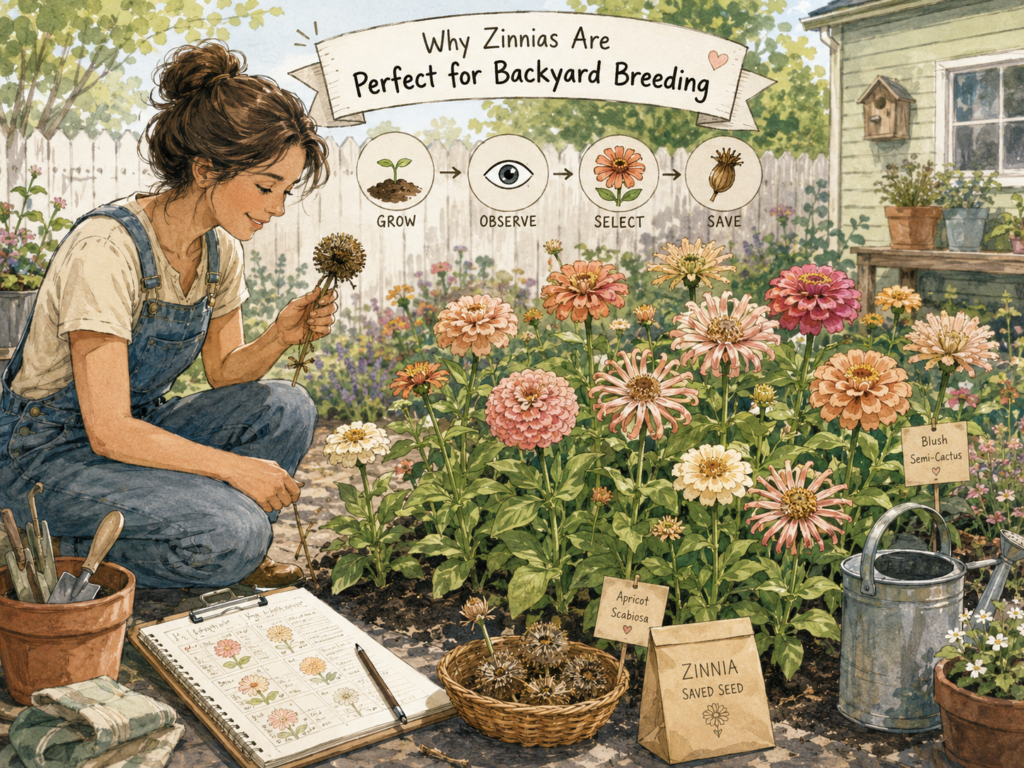
In my climate, when I start them early indoors, zinnias can carry me from spring into summer and keep going until first frost. They germinate quickly, grow visibly, bloom generously, attract pollinators, and produce flowers that can be cut again and again. A small patch of zinnias can provide months of weekly bouquets. Some blooms can act as focal flowers. Others can serve as mass flowers. Smaller forms can soften an arrangement almost like filler.
For a backyard gardener, this matters.
A zinnia patch is not only a flower patch. It can become a mood calendar. It gives you something to anticipate, something to observe, something to cut, something to share, and something to save seed from for next year.
This view helps separate true one-time learning costs from reusable supplies and recurring garden inputs.
A seed is a small act of belief. You plant it before there is proof. You water before there is a flower. You wait before there is a reward. When the flower finally opens, it confirms that care can become visible. When the seed head dries and you save seed for next year, you are quietly saying that another season is worth preparing for.
This is why I love open-pollinated zinnias so much. They do not keep the gardener only in the role of consumer. They invite participation. You can observe variation, notice which plants you love, mark the standouts, and save seed from the flowers you want to see again. You are not only growing a plant. You are entering a relationship with a living population.
My personal favorite right now is the Antique Pompon type. I love the globe-shaped flowers and the tight centers where the usual button of pollen almost disappears. They feel old-fashioned, charming, and still full of possibility. They are not finished in the way a uniform commercial hybrid is finished. They are alive as a selection project. Each plant may show something slightly different. Each seed head may carry next year’s surprise.
It gives us a future to participate in.
The book I am writing is not about becoming a perfect gardener. It is not about production gardening, flower farming, or creating an impressive backyard for social media. In fact, some of the most important chapters are about starting small: one pot, twenty plants, beginner-friendly flowers, easy herbs, and seasonal anchors that give reliable wins before the gardener takes on more difficult dream plants.
A pot of basil counts.
A marigold beside an apartment door counts.
A small patch of zinnias counts.
A few herbs in a kitchen window count.
Not everyone owns land. Not everyone has time, money, strength, or space for a large garden. But gardening should not belong only to people with acreage, raised beds, greenhouses, and perfect tools. If gardening is good for us, then it should be accessible. It should be available to renters, apartment dwellers, busy parents, older adults, people recovering from illness, and anyone who has enough light for one living plant.
It is not a promise that the garden will cure everything.
It is an argument that small gardens matter.
They matter because sunlight matters. Movement matters. Nature matters. Purpose matters. Beauty matters. Anticipation matters. Hope matters.
The garden does not cure life.
But it can make life more textured, more rhythmic, more bearable, and more alive. It can give us a reason to go outside tomorrow. It can give us something to look forward to when the future feels flat. It can give us a small place where care becomes visible.
Sometimes the smallest garden is the one that opens the door.
And sometimes one flower is enough to remind us that another season is still possible.