What I Learned (After Taking Both Floret & Bouquet Bootcamp)
Floret Flower Arranging Workshop
What I Learned (After Taking Both Floret & Bouquet Bootcamp)
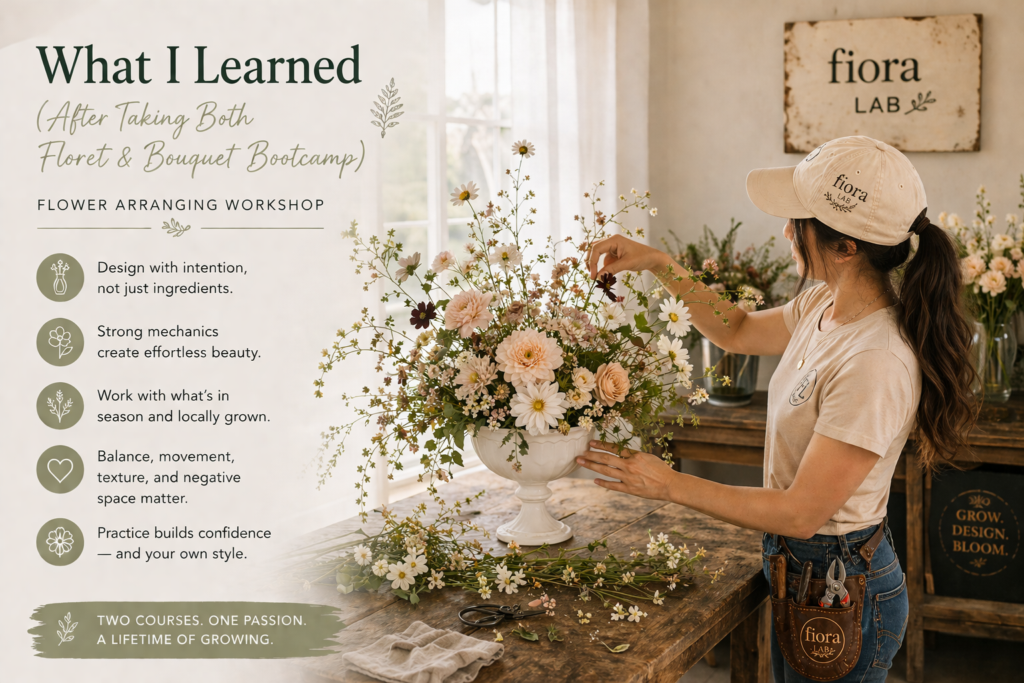
I took both the Floret Flower Arranging Workshop and Bouquet Bootcamp because I wanted to understand why some arrangements look professional while others feel chaotic—even with beautiful flowers.
What I realized surprised me:
👉 Floret is NOT random, emotional, or purely artistic.
👉 It is an extremely structured system designed to look effortless.
The difference is that the structure is hidden.
1-Minute Summary (Read This First)
- Floret uses a structured 6-ingredient system
- Strong focus on floral mechanics (cages, pins, structure)
- Designs follow a hidden asymmetrical formula similar to Ikebana
- You will want to plant:
- You will likely buy:
Most valuable lesson:
👉 Being the face of your business
Least valuable section:
👉 Designer profiles (more storytelling than teaching)
Biggest realization:
Floret is not random or “feeling-based.”
It is a controlled system built to appear natural.
Why This Post Is Different
I took BOTH:
- Bouquet Bootcamp
- Floret Flower Arranging Workshop
 They are NOT teaching the same thing.
Most people simplify it as:
- Bootcamp = structure
- Floret = art
That’s not actually true.Both are systems.
They simply organize flowers differently.
The Real Difference (Important)
Bouquet Bootcamp
Bouquet Bootcamp teaches:
- clear formulas
- ratios (3/5/8)
- mass / line / form / filler
- very explicit structure
You can follow it step-by-step.
It feels almost architectural.
Floret
Floret teaches:
- fundamental ingredients
- asymmetrical placement
- controlled color palettes
- mechanics + layering
Less obvious… but still highly structured.
The truth:
Bootcamp = visible system
Floret = hidden system
The 6 Fundamental Ingredients (Floret Method)
One thing Floret explains very differently from traditional floral design is the idea of using 6 fundamental ingredients when building natural garden-style arrangements.
At first glance, the arrangements look loose and organic.
👉 But underneath, the structure is extremely intentional.
Floret organizes arrangements into two major layers.
Foundation Layer (The Structure)
The first 3 ingredients build the framework of the arrangement.
These are usually placed lower and closer to the base of the bouquet or vessel.
1. Structural Foliage
This creates the overall shape and movement.
Examples:
👉 This acts like the skeleton of the arrangement.
2. Supporting Ingredient
These bridge transitions between flowers and foliage.
They help connect movement throughout the arrangement.
👉 Without this layer, arrangements can feel disconnected.
3. Textural Ingredient
This creates variation and complexity.
Examples:
👉 This prevents arrangements from feeling flat.
Floral Layer (The Visual Focus)
The next 3 ingredients create the actual floral movement and focal impact.
4. Supporting Flowers
These connect focal flowers throughout the arrangement.
👉 They distribute color and rhythm evenly.
5. Focal Flowers
These are the flowers your eye notices first.
Examples:
👉 These create visual anchors.
6. Airy Accents
This is one of the most recognizable parts of Floret’s style.
Examples:
👉 These soften the arrangement and create movement.
Without airy accents, arrangements can feel stiff and overly dense.
The Real Goal
The goal is NOT randomness.
The goal is controlled naturalism.
Every ingredient has a purpose.
The arrangement is designed to feel:
- loose
- effortless
- garden-inspired
…but underneath, it is carefully structured.
That was one of the biggest realizations I had after taking the course.
Color Is Highly Controlled (Not Random)
This was another major realization.
Floret is NOT:
“use whatever looks pretty”
It is actually:
stay within a controlled color family.
You see:
- layered tones
- subtle shifts
- restrained palettes
- intentional repetition
This is why arrangements still feel cohesive even with many flower types.
The Hidden Geometry (This Is the Real System)
This was probably the biggest realization of the workshop.
Floret arrangements consistently follow asymmetrical placement:
- one taller side (usually left)
- one slightly lower side (right)
- shortest point near center
This is NOT random.
It strongly resembles Ikebana principles:
- Heaven = tallest
- Human = middle
- Earth = lowest
Once I noticed this, everything changed.
I realized every arrangement is intentionally shaped.
This Course Is Really About Mechanics
This is where Floret separates itself from most floral courses.
Not spiral technique.
Mechanics.
What you actually learn:
- floral cages
- pin frogs
- structural anchoring
- vessel-based design
Translation:
You learn how to:
- build arrangements that hold properly
- control placement
- create intentional movement
- manipulate shape without foam
This completely changed how I see arranging.
What You Will Buy After This Course
Let’s be honest.
This course changes how you shop.
Plants You Will Suddenly Want
You will probably want to grow:
Because Floret uses them constantly.
Why?
- movement
- branching structure
- natural shape
- transitional layering
These are not just “filler.”
They are structural ingredients.
Tools You Will Buy
You will also likely buy:
- floral pins
- floral cages
- mechanics supplies
- compote vessels
If you follow this style, mechanics become unavoidable.
Most Valuable Lesson (Applies To Any Business)
“Being the Face of Your Business”
This was the strongest section in the course for me.
Not arranging.
Not flowers.
Branding.
The lesson teaches:
- show your face
- share your story
- connect with people directly
This applies far beyond flowers.
It applies to:
- Fiora Lab
- blogging
- social media
- any creative business
Biggest realization:
People don’t just buy flowers.
They buy YOU.
Least Valuable Section (Honest Take)
MODULE 10 — Designer Profiles
My personal experience:
- mostly storytelling
- minimal instruction
- not highly actionable
It felt more like:
- interviews
- personal journeys
- showing work
Beautiful to watch.
But not something I could directly apply.
What Floret Does Better
1. Teaches structure disguised as “natural”
This is the magic of the course.
You learn control without making arrangements feel rigid.
2. Emphasizes mechanics
This is one of the biggest gaps in most floral education.
Floret fills that gap extremely well.
3. Connects design with branding
Very few floral courses teach this.
Floret understands that:
aesthetic + identity + storytelling = business
What It Does NOT Do Well
👉 Some people may struggle if they need rigid formulas.
My Personal Take (After Taking Both)
Bouquet Bootcamp gave me:
If I simplify everything:
Bootcamp = framework
Floret = refinement
Biggest Realizations
1. Floret is NOT “just art”
It is a structured system.
2. Placement matters more than flowers
height + asymmetry = everything
3. Color discipline is critical
too many colors = chaos
4. Mechanics change everything
this is what makes arrangements hold properly
Final Thought
I used to think floral design was mostly creativity.
Now I realize:
it’s structure + control.
Floret simply hides the structure extremely well.
That’s why the arrangements feel effortless.
If You’re Choosing Between Courses
Take Bouquet Bootcamp if you want:
Best Option
Take both.
One teaches the framework.
The other teaches refinement.
Together, they completely changed how I see flowers.