From Soil to Spiral — What I Learned in Bouquet Bootcamp

By fioralab

April 28, 2026

Share

Contents

I have taken the course bouquet bootcamp and color harmony from the floral coach. This is what I have learned.

From Soil to Spiral — What I Learned in Bouquet Bootcamp

1-Minute Summary (Read This First)

👉 The real shift:


I stopped “growing flowers” and started solving design problems in the soil.

From Garden to Design Studio

I used to look at my garden as a collection of plants I liked (ranunculus, dahlias, lisianthus, and heirloom mums)


Now I see it as:

  • a design studio
  • an ingredient list
  • a system

👉 A bouquet doesn’t start when you cut flowers
👉 It starts when you decide what to grow

Solving the Design Problem in the Garden

Instead of planting randomly, I now assign every plant a job.

The 4 Essential Flower Forms

Mass Flowers (Focal / Hero)

These carry the bouquet.


  • Dinnerplate Dahlias (primary hero flower) are now my strongest focal. 
    • large
    • dramatic
    • high visual weight

  • Lisianthus
  • Ranunculus
  • Sunflowers
👉 This acts like the skeleton of the arrangement.
Support Mass (Secondary Focal)

These support the hero flowers.

Line Flowers (Structure + Movement)
Form Flowers (Shape + Contrast) : These break repetition and add interest
Filler & Foliage (Depth) : This is what creates depth, shadows and layering

The Science of Color

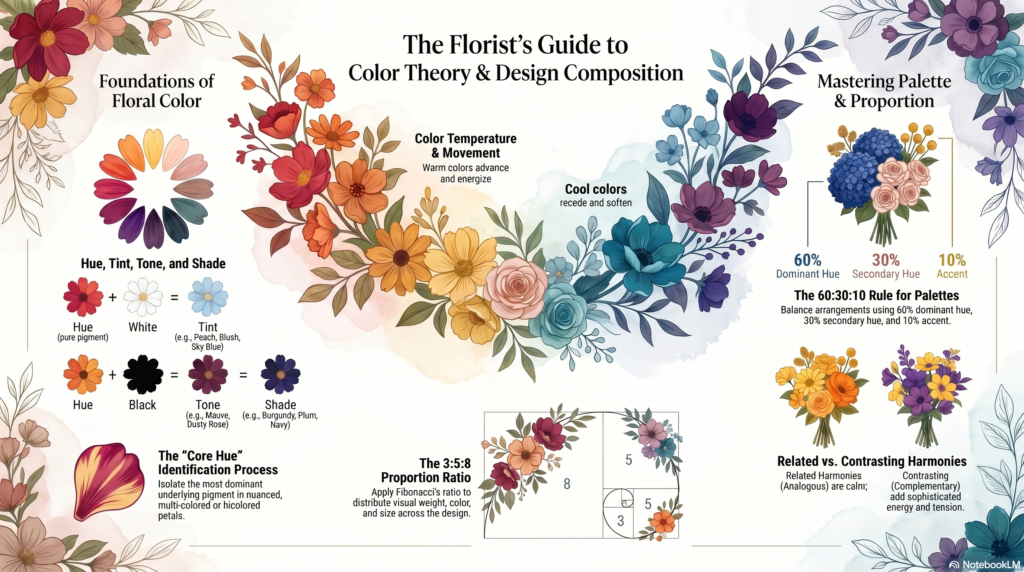
The 60:30:10 Rule

👉 Prevents chaos

Creating Depth
Color Behavior

👉 You control the eye movement

The Geometry of Design

3 / 5 / 8 Ratio

👉 This keeps hierarchy clear

Asymmetrical Balance

👉 More natural and high-end

Editing (Game Changer)

👉 Design = removing


I now:

create negative space
Technique in the Hand
Hydration

Designing with My Seed List

Now I think in systems.

My “Mini Flower Pull”
  • Mass → Dinnerplate Dahlias, Lisianthus
  • Support Mass → Zinnias, Ranunculus
  • Line → Larkspur, Delphinium, Jasmine
  • Form → Scabiosa
  • Filler → Gomphrena
  • Foliage → Ninebark

👉 This guarantees a complete palette.

My Go-To Bouquet Recipe
  • 8 → Dinnerplate Dahlias (hero)
  • 5 → Zinnias or Ranunculus
  • 3 → Larkspur / Delphinium
  • 2 → Scabiosa
  • 3 → Ninebark
  • 2–3 → Jasmine
Easy Garden Version

If simplifying:


  • Sunflower → focal
  • Zinnias → support
  • Gomphrena → filler
  • Greens → structure

👉 Still works—but not as refined

What Changed After This Course

Before:

  • random planting
  • inconsistent bouquets

After:

  • intentional system
  • repeatable designs

Biggest Realizations

1. Design starts in the soil
2. Hero flowers matter

👉 Dahlias changed everything

3. Easy flowers still work

👉 If placed correctly

4. Structure > quantity

Final Thought

I used to grow flowers I liked.

Now I grow flowers with purpose.

From the same field journal

🌸 From Soil to Spiral — What I Learned in Bouquet Bootcamp

⚡ 1-Minute Summary (Read This First)

  • Professional floral design starts in the garden, not the vase
  • Every plant must have a role: Mass, Line, Form, or Filler
  • The 60:30:10 color rule prevents messy bouquets
  • Great arrangements follow structure + ratios (3/5/8)
  • Easy flowers like zinnias and sunflowers work—but only with proper placement

👉 The real shift:
I stopped “growing flowers” and started solving design problems in the soil.

🌱 From Garden to Design Studio

I used to look at my garden as a collection of plants I liked (ranunculus, dahlias, lisianthus, and heirloom mums)

Now I see it as:

  • a design studio
  • an ingredient list
  • a system

👉 A bouquet doesn’t start when you cut flowers
👉 It starts when you decide what to grow

🌿 Solving the Design Problem in the Garden

Instead of planting randomly, I now assign every plant a job.

The 4 Essential Flower Forms

🌸 Mass Flowers (Focal / Hero)

These carry the bouquet.

  • Dinnerplate Dahlias (primary hero flower) are now my strongest focal. 
    • large
    • dramatic
    • high visual weight
  • Lisianthus
  • Ranunculus
  • Sunflowers

🌼 Support Mass (Secondary Focal)

These support the hero flowers.

  • Zinnias (productive,  easy to grow and great for volume). They look better as support mass, not always the hero
  • Ranunculus (depending on season)

🌿 Line Flowers (Structure + Movement)

  • Larkspur / Delphinium
  • Flowering Tobacco
  • Jasmine

🌱 Form Flowers (Shape + Contrast) : These break repetition and add interest

  • Scabiosa ‘Purple Lace’
  • Korean Spice Viburnum


🌿 Filler & Foliage (Depth) : This is what creates depth, shadows and layering

  • Gomphrena
  • Ninebark


🎨 The Science of Color

The 60:30:10 Rule

  • 60% → dominant
  • 30% → secondary
  • 10% → accent

👉 Prevents chaos

Creating Depth

  • Tints → soft, forward
  • Shades → deep, receding
  • Tones → blending

Color Behavior

  • Warm → advance
  • Cool → recede

👉 You control the eye movement

📐 The Geometry of Design

3 / 5 / 8 Ratio

  • 8 → Dinnerplate Dahlia (hero)
  • 5 → Zinnias / Ranunculus
  • 3 → Line flowers

👉 This keeps hierarchy clear

Asymmetrical Balance

  • group in 2s or 3s
  • mirror loosely

👉 More natural and high-end

✂️ Editing (Game Changer)

👉 Design = removing

I now:

  • remove excess leaves
  • open stems
  • create negative space

✂️ Technique in the Hand

Spiral Technique

  • angled placement
  • rotate bouquet

Hydration

  • harvest at peak hydration
  • clean tools

🌱 Designing with My Seed List

Now I think in systems.

My “Mini Flower Pull”

  • Mass → Dinnerplate Dahlias, Lisianthus
  • Support Mass → Zinnias, Ranunculus
  • Line → Larkspur, Delphinium, Jasmine
  • Form → Scabiosa
  • Filler → Gomphrena
  • Foliage → Ninebark

👉 This guarantees a complete palette.

My Go-To Bouquet Recipe

  • 8 → Dinnerplate Dahlias (hero)
  • 5 → Zinnias or Ranunculus
  • 3 → Larkspur / Delphinium
  • 2 → Scabiosa
  • 3 → Ninebark
  • 2–3 → Jasmine

🌸 Easy Garden Version

If simplifying:

  • Sunflower → focal
  • Zinnias → support
  • Gomphrena → filler
  • Greens → structure

👉 Still works—but not as refined

🔑 What Changed After This Course

Before:

  • random planting
  • inconsistent bouquets

After:

  • intentional system
  • repeatable designs

🔑 Biggest Realizations

1. Design starts in the soil

2. Hero flowers matter

👉 Dahlias changed everything

3. Easy flowers still work

👉 If placed correctly

4. Structure > quantity

📌 Final Thought

I used to grow flowers I liked.

Now I grow flowers with purpose.