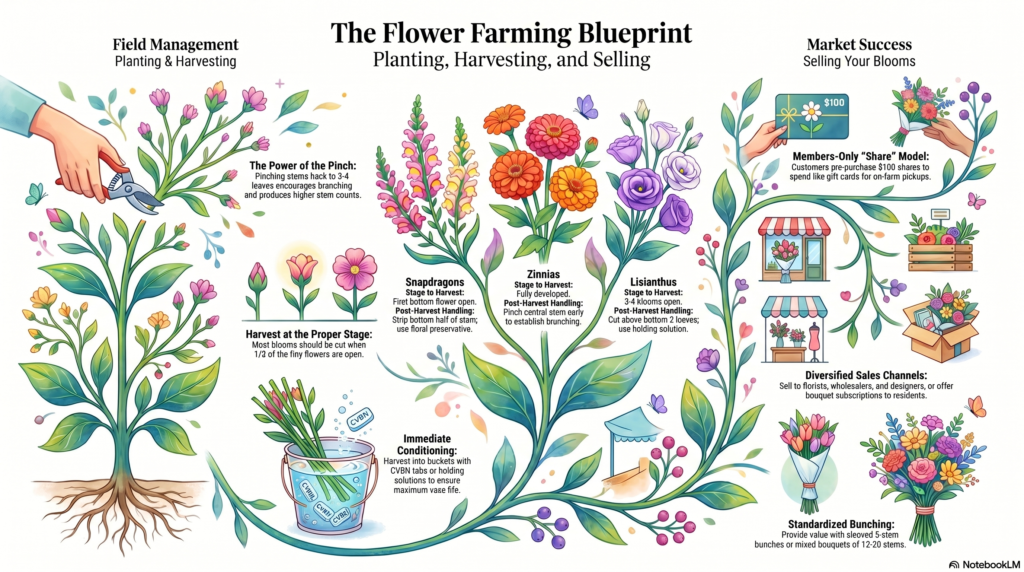
What I Learned After Taking The Gardener’s Workshop Lisa Mason Ziegler’s and Dave Dowling’s Flower Farming Course

By fioralab

April 28, 2026

Share

Contents

I took Lisa Mason Ziegler's Flower Farming School Online: The Basics, Annual Crops, Marketing & More and Dave Dowling's Bulbs, Perennials, Woodies, and More! Here is what I learned.
If you’re asking “Should I take the Gardener’s Workshop course?” the answer is: Yes, if you want to understand how flower farms work. No, if you expect a simple home gardening guide. Is it worth the cost? Lisa’s course is worth it for learning systems and timing. Dave’s course is less useful for home gardeners. What did I actually learn? Timing matters more than technique, fall planting is a major advantage, and simpler systems work better for home gardeners.

Course Overview

I took two courses from Lisa Mason Ziegler through the Gardener’s Workshop online farming and business schools, along with Dave Dowling’s course: Flower Farming School Online: The Basics, Annual Crops, Marketing & More, and Bulbs, Perennials, Woodies & More. At the time, each course was $695, with a $100 discount if purchased together.

1-Minute Summary (Read This First)

This course is excellent for understanding flower farming systems, but not everything applies to home gardeners. Soil blocking was too messy for me. Plugs can help, but my experience was not great. Transplanting zinnias and sunflowers adds unnecessary stress. Irrigation and landscape fabric felt too complex for home use. Fall planting completely changed how I grow cool-season flowers. The biggest lesson is that I stopped trying to follow everything exactly and started adapting it to my own system. One important realization is that you should not place your cut flower garden where you can constantly see it, because you won’t want to cut anything. You also cannot combine a cut garden with a pollinator garden, since one requires harvesting before pollination while the other is meant for butterflies and hummingbirds.

What I Expected vs What I Learned

When I signed up, I thought I was going to learn how to grow flowers better, but what I actually learned was how flower farms think, how systems reduce labor, and how timing controls everything. Flower farms optimize for scale, efficiency, and consistency, while home gardeners need simplicity, flexibility, and something manageable.

What Didn’t Work for Me (As a Home Gardener)

Soil blocking was heavily recommended, but in my experience it was messy, inconsistent, time-consuming, and the blocks often fell apart, so I went back to trays. Plugs were also recommended, especially for lisianthus and trachelium, but ordering from Farmer Bailey required a minimum of three trays with 125 plugs each, and my experience was poor condition, low survival, and overall disappointment, so while plugs can work, they are not guaranteed success. Starting sunflowers and zinnias indoors and transplanting them also didn’t work well for me because hardening off became the biggest issue, especially with a full-time schedule, making direct sowing far more practical, less stressful, and more reliable. Drip irrigation systems felt overly complicated, time-consuming, and unnecessary for a small home setup, so I use a hose and watering can instead. Landscape fabric and biofilm were also too restrictive, harder to adjust, and not visually appealing, so I prefer flexible, natural beds.

What Actually Worked (High-Impact Lessons)

Fall planting was the biggest game changer. If a plant is winter hardy in your zone, you can plant it in fall, and when I tested this with snapdragons, delphiniums, and larkspur, they were taller, stronger, healthier, and bloomed earlier than my spring plantings. This works because roots establish early, plants mature slowly, and stems become stronger before heat arrives. Timing turned out to matter more than technique, since you can do everything right but still fail if your timing is off. This applies to seed starting, transplanting, and harvesting. Harvest timing also matters, since flowers should be cut early before pollen matures, which improves vase life. Another key realization is that every extra step adds friction, whether it’s soil blocking, plugs, transplanting, irrigation, or landscape fabric, so fewer steps lead to more success.

What I Do Now (My Actual System)

I simplified everything. I use trays instead of soil blocks, a consistent mix, and water twice per week. I grow lisianthus, flowering tobacco, and eucalyptus in trays and will use plugs only if needed, while zinnias and sunflowers are direct sown. Dahlias are my main focal flower, and all cool-season flowers are fall planted. My system now focuses on fewer steps, less complexity, and something repeatable.

Dave Dowling Course — What Matters Most

The biggest shift from this course is understanding that ordering timing matters more than planting skill. Most bulbs must be ordered months in advance, and if you miss the ordering window, you miss the entire season. While the course includes useful timelines, much of it focuses on selecting perennials, plant spacing, and systems that are more relevant to production farming. Advanced methods like tunnels, lighting systems, and temperature control are not practical for home gardeners and can be ignored.

Is Gardener’s Workshop Worth It?

Lisa’s course: Yes — highly recommended for learning systems, timing, and how to think like a grower.


Dave’s course: Not necessary for most home gardeners — more focused on crop selection and farming-scale systems.

Biggest Takeaways

Not all farm systems apply to home gardeners, simplicity always wins, fall planting is a major advantage, hardening off is a major failure point for busy people, and timing matters more than tools.

Final Verdict

Lisa’s course is absolutely worth taking because it teaches you how to think, plan, and build a system that actually works. Dave’s course is not necessary for most home gardeners, as it focuses more on selecting perennials, plant spacing, and farming-scale concepts like tunnels, lighting systems, and complex controls that do not apply to typical home setups. The real value comes from learning the system from Lisa’s course and adapting it to your own reality.

Bonus: Content Strategy That Helped Me Stay Consistent

If you’re sharing your gardening journey online, this weekly structure helped keep things simple and consistent: Monday is for teaching something helpful, Tuesday is for showing real life, Wednesday is for sharing struggles and wins, Thursday is for highlighting your work or services, Friday is for results or satisfying moments, Saturday is for your story or team, and Sunday is for explaining your “why.”
From the same field journal

If you’re asking “Should I take the Gardener’s Workshop course?” the answer is: Yes, if you want to understand how flower farms work. No, if you expect a simple home gardening guide. Is it worth the cost? Lisa’s course is worth it for learning systems and timing. Dave’s course is less useful for home gardeners. What did I actually learn? Timing matters more than technique, fall planting is a major advantage, and simpler systems work better for home gardeners.


Course Overview

I took two courses from Lisa Mason Ziegler through the Gardener’s Workshop online farming and business schools, along with Dave Dowling’s course: Flower Farming School Online: The Basics, Annual Crops, Marketing & More, and Bulbs, Perennials, Woodies & More. At the time, each course was $695, with a $100 discount if purchased together.


1-Minute Summary (Read This First)

This course is excellent for understanding flower farming systems, but not everything applies to home gardeners. Soil blocking was too messy for me. Plugs can help, but my experience was not great. Transplanting zinnias and sunflowers adds unnecessary stress. Irrigation and landscape fabric felt too complex for home use. Fall planting completely changed how I grow cool-season flowers. The biggest lesson is that I stopped trying to follow everything exactly and started adapting it to my own system. One important realization is that you should not place your cut flower garden where you can constantly see it, because you won’t want to cut anything. You also cannot combine a cut garden with a pollinator garden, since one requires harvesting before pollination while the other is meant for butterflies and hummingbirds.


What I Expected vs What I Learned

When I signed up, I thought I was going to learn how to grow flowers better, but what I actually learned was how flower farms think, how systems reduce labor, and how timing controls everything. Flower farms optimize for scale, efficiency, and consistency, while home gardeners need simplicity, flexibility, and something manageable.


What Didn’t Work for Me (As a Home Gardener)

Soil blocking was heavily recommended, but in my experience it was messy, inconsistent, time-consuming, and the blocks often fell apart, so I went back to trays. Plugs were also recommended, especially for lisianthus and trachelium, but ordering from Farmer Bailey required a minimum of three trays with 125 plugs each, and my experience was poor condition, low survival, and overall disappointment, so while plugs can work, they are not guaranteed success. Starting sunflowers and zinnias indoors and transplanting them also didn’t work well for me because hardening off became the biggest issue, especially with a full-time schedule, making direct sowing far more practical, less stressful, and more reliable. Drip irrigation systems felt overly complicated, time-consuming, and unnecessary for a small home setup, so I use a hose and watering can instead. Landscape fabric and biofilm were also too restrictive, harder to adjust, and not visually appealing, so I prefer flexible, natural beds.


What Actually Worked (High-Impact Lessons)

Fall planting was the biggest game changer. If a plant is winter hardy in your zone, you can plant it in fall, and when I tested this with snapdragons, delphiniums, and larkspur, they were taller, stronger, healthier, and bloomed earlier than my spring plantings. This works because roots establish early, plants mature slowly, and stems become stronger before heat arrives. Timing turned out to matter more than technique, since you can do everything right but still fail if your timing is off. This applies to seed starting, transplanting, and harvesting. Harvest timing also matters, since flowers should be cut early before pollen matures, which improves vase life. Another key realization is that every extra step adds friction, whether it’s soil blocking, plugs, transplanting, irrigation, or landscape fabric, so fewer steps lead to more success.


What I Do Now (My Actual System)

I simplified everything. I use trays instead of soil blocks, a consistent mix, and water twice per week. I grow lisianthus, flowering tobacco, and eucalyptus in trays and will use plugs only if needed, while zinnias and sunflowers are direct sown. Dahlias are my main focal flower, and all cool-season flowers are fall planted. My system now focuses on fewer steps, less complexity, and something repeatable.


Dave Dowling Course — What Matters Most

The biggest shift from this course is understanding that ordering timing matters more than planting skill. Most bulbs must be ordered months in advance, and if you miss the ordering window, you miss the entire season. While the course includes useful timelines, much of it focuses on selecting perennials, plant spacing, and systems that are more relevant to production farming. Advanced methods like tunnels, lighting systems, and temperature control are not practical for home gardeners and can be ignored.


Is Gardener’s Workshop Worth It?

Lisa’s course: Yes — highly recommended for learning systems, timing, and how to think like a grower.
Dave’s course: Not necessary for most home gardeners — more focused on crop selection and farming-scale systems.


Biggest Takeaways

Not all farm systems apply to home gardeners, simplicity always wins, fall planting is a major advantage, hardening off is a major failure point for busy people, and timing matters more than tools.


Final Verdict

Lisa’s course is absolutely worth taking because it teaches you how to think, plan, and build a system that actually works. Dave’s course is not necessary for most home gardeners, as it focuses more on selecting perennials, plant spacing, and farming-scale concepts like tunnels, lighting systems, and complex controls that do not apply to typical home setups. The real value comes from learning the system from Lisa’s course and adapting it to your own reality.


Bonus: Content Strategy That Helped Me Stay Consistent

If you’re sharing your gardening journey online, this weekly structure helped keep things simple and consistent: Monday is for teaching something helpful, Tuesday is for showing real life, Wednesday is for sharing struggles and wins, Thursday is for highlighting your work or services, Friday is for results or satisfying moments, Saturday is for your story or team, and Sunday is for explaining your “why.”