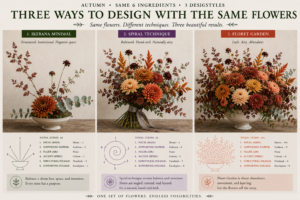
Gone are the days of the perfectly round, tightly packed bouquet.You know the one—symmetrical, predictable, everything evenly spaced.
It’s clean……but it can also feel flat.What changed everything for me wasn’t growing more flowers.It was realizing that the exact same ingredients can create completely different arrangements depending entirely on the design style.
Instead of asking:
👉 “What flowers should I use?”
I started asking:
👉 “How should I arrange them?”
And that’s where these three styles completely changed how I design:
Most flower farmers think they need more flowers.But after my first real season growing cut flowers, I realized something surprising:
👉 The biggest difference in floral design is NOT the flowers.It’s the design philosophy.I started arranging the exact same flowers in three completely different ways:
…depending entirely on mechanics and structure.This article shows how I use the same core flower system across all four seasons while creating completely different aesthetics.
One of the biggest things that confused me at first:
👉 flower farming categories are NOT the same as floral design categories.
When I organize my flower farm, I think in terms of:
That helps me plan crops across seasons.But Floret approaches flowers differently.
👉 Floret organizes flowers based on DESIGN FUNCTION inside the arrangement itself.
That means the same flower can behave differently depending on placement.
Example:
👉 Bells of Ireland can function as:
…depending on how it is used.So instead of rigid flower “types,” Floret focuses on ingredient layers.
That was one of the biggest mindset shifts for me.
Most floral tutorials teach:
👉 different flowers = different arrangements
But real floral design works differently.
The real question is:
👉 What happens when you use the SAME flowers with different mechanics?
That’s where floral design becomes visible.
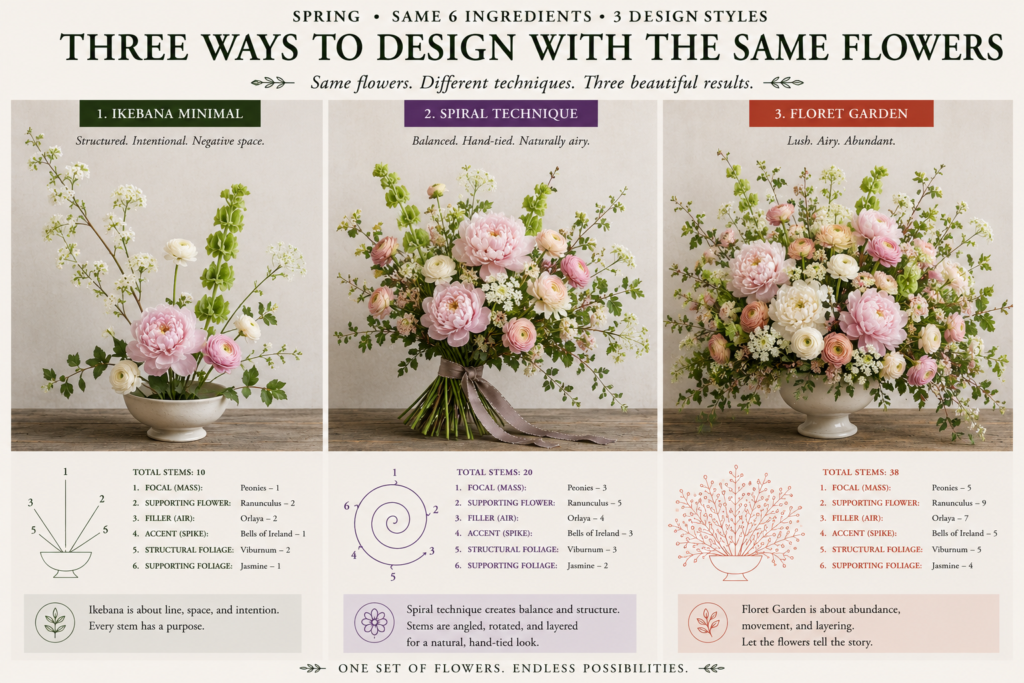
This is the opposite of a full bouquet.Ikebana minimal is about less—but with purpose.
You are not filling space.
👉 You are shaping it.
For this design, I use:
This setup forces discipline.
Every stem must be placed intentionally.
Nothing is extra. Nothing is hidden.
But it is also the most unforgiving because every placement is visible.
👉 8–12 stems total
This style uses the fewest ingredients visually even when using the same flowers.
This is where design meets efficiency.Unlike the other styles, there is usually no vessel involved.
Instead:
The stems are placed at approximately a 45-degree angle while rotating consistently in one direction.
This allows the bouquet to:
This is the style that works best if I want:
👉 18–25 stems total
This sits directly between Ikebana and Floret Garden in density.
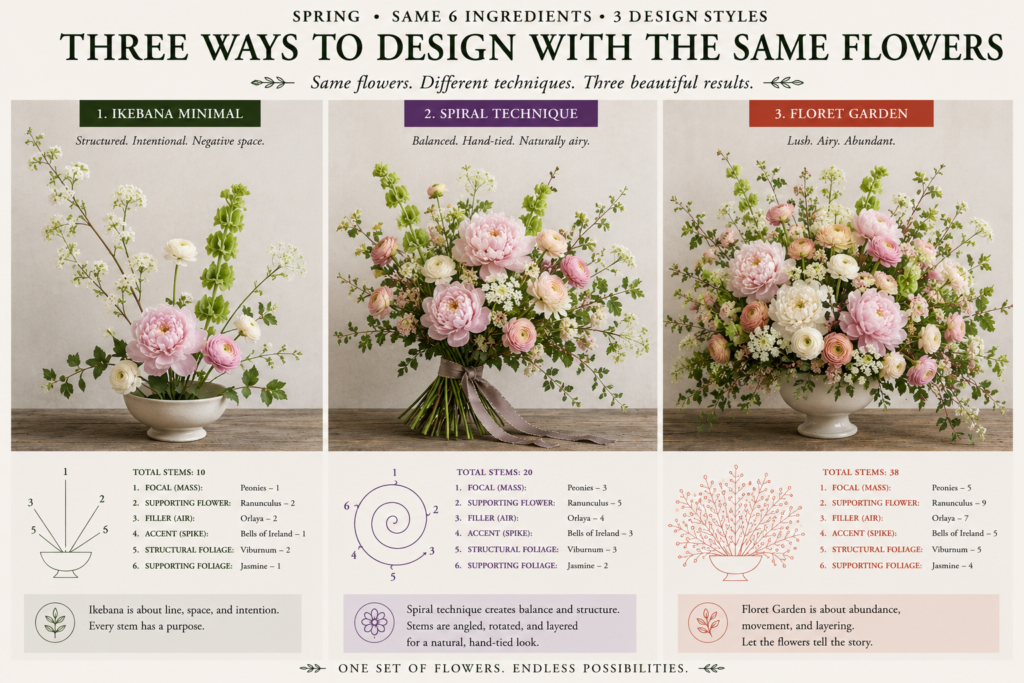
If Ikebana is restraint…
👉 Floret Garden style is layered abundance.
This is the look that feels like:
👉 I walked into the garden, clipped what was blooming, and arranged it naturally.But after taking the Floret workshop, I realized something important:
👉 The arrangements only LOOK effortless.
Underneath, they are highly structured.
Floret teaches arrangements in layers—not rigid flower categories.
The arrangement is built from the base upward.
👉 The first 3 ingredients create the structure.
👉 The next 3 ingredients create the visual movement.
This is why Floret arrangements feel natural while still looking cohesive.
These ingredients are usually placed lower and closer to the vessel.
They create:
This creates the silhouette and overall movement.
Examples from my garden:
This bridges transitions between flowers and foliage.
Examples:
This adds variation and complexity.
Examples:
Once the structure is built, the next ingredients create floral emphasis and softness.
These distribute color and rhythm throughout the arrangement.
Examples:
These are the flowers the eye notices first.
Examples:
👉 These create softness, looseness, and movement.
Without airy accents, arrangements quickly feel stiff.
The goal is NOT randomness.
The goal is controlled naturalism.
👉 Every ingredient has a purpose.
The arrangement is designed to feel:
…but underneath, it is carefully structured.
That was one of the biggest realizations I had after taking the course.
Another major realization:
Floret is NOT:
👉 “just use whatever looks pretty.”
It is actually:
👉 That is why the arrangements feel cohesive even with many ingredients.
This was probably the biggest breakthrough for me.Floret arrangements consistently follow:
Once I noticed this…
👉 I started seeing intentional placement everywhere.
But without mechanics and structure…
👉 it quickly turns messy.
👉 30–45+ stems total
This style uses dramatically more material than Ikebana.
That becomes important economically because design style directly affects stem usage.
Two varieties gave me leaves but no real bloom performance:
These were especially frustrating because they were not complete failures. They sprouted, grew foliage, and looked like they might keep going.
But they never gave me the flowers I was hoping for.This is one of the harder parts of growing ranunculus. A sprout feels like a win in the beginning. But sprouting is only the first checkpoint. Blooming is the real test.
👉 9–11 stems
Autumn became dramatically better once I stopped treating dahlias as the main focal flower and leaned heavily into mums.
Mums create:
Without a greenhouse or hoop house, winter arrangements naturally become simpler.
And honestly?
👉 That simplicity made me better at arranging.
Winter forced me to focus on:
👉 Same flowers.
Completely different feeling.
This is where it becomes personal.
Do I want:
👉 They simply create different emotions using the same ingredients.
…depending entirely on mechanics and structure.
I used to think I needed more flowers.
Now I think I needed:
Same ingredients.
Different mechanics.
Completely different result.
That is when arranging stopped feeling random…
…and started feeling like design.
Gone are the days of the perfectly round, tightly packed bouquet.
You know the one—symmetrical, predictable, everything evenly spaced.
It’s clean…
…but it can also feel flat.
What changed everything for me wasn’t growing more flowers.
It was realizing that the exact same ingredients can create completely different arrangements depending entirely on the design style.
Instead of asking:
“What flowers should I use?”
I started asking:
“How should I arrange them?”
And that’s where these three styles completely changed how I design:
Same flowers.
Completely different results.
Most flower farmers think they need more flowers.
But after my first real season growing cut flowers, I realized something surprising:
The biggest difference in floral design is NOT the flowers.
It’s the design philosophy.
I started arranging the exact same flowers in three completely different ways:
And suddenly:
…depending entirely on mechanics and structure.
This article shows how I use the same core flower system across all four seasons while creating completely different aesthetics.
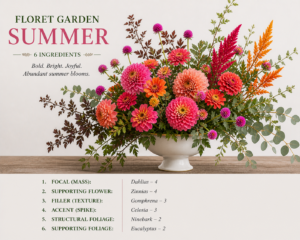
This is the exact mix I rely on for year-round flower arranging.
These are the flowers that visually carry the arrangement.

These help transition between focal flowers and soften the arrangement.

These create movement, silhouette, and framework.

These create directional movement and shape.
One of the biggest things that confused me at first:
flower farming categories are NOT the same as floral design categories.
When I organize my flower farm, I think in terms of:
That helps me plan crops across seasons.
But Floret approaches flowers differently.
Floret organizes flowers based on DESIGN FUNCTION inside the arrangement itself.
That means the same flower can behave differently depending on placement.
Example:
Bells of Ireland can function as:
…depending on how it is used.
So instead of rigid flower “types,” Floret focuses on ingredient layers.
That was one of the biggest mindset shifts for me.
Most floral tutorials teach:
different flowers = different arrangements
But real floral design works differently.
The real question is:
What happens when you use the SAME flowers with different mechanics?
That’s where floral design becomes visible.
This is the opposite of a full bouquet.
Ikebana minimal is about less—but with purpose.
You are not filling space.
You are shaping it.
For this design, I use:
This setup forces discipline.
Every stem must be placed intentionally.
Nothing is extra.
Nothing is hidden.
But it is also the most unforgiving because every placement is visible.
8–12 stems total
This style uses the fewest ingredients visually even when using the same flowers.
This is where design meets efficiency.
Unlike the other styles, there is usually no vessel involved.
Instead:
That’s it.
The stems are placed at approximately a 45-degree angle while rotating consistently in one direction.
This allows the bouquet to:
This is the style that works best if I want:
18–25 stems total
This sits directly between Ikebana and Floret Garden in density.
If Ikebana is restraint…
Floret Garden style is layered abundance.
This is the look that feels like:
I walked into the garden, clipped what was blooming, and arranged it naturally.
But after taking the Floret workshop, I realized something important:
The arrangements only LOOK effortless.
Underneath, they are highly structured.
Floret teaches arrangements in layers—not rigid flower categories.
The arrangement is built from the base upward.
The first 3 ingredients create the structure.
The next 3 ingredients create the visual movement.
This is why Floret arrangements feel natural while still looking cohesive.
These ingredients are usually placed lower and closer to the vessel.
They create:
This creates the silhouette and overall movement.
Examples from my garden:
This acts like the skeleton of the arrangement.
This bridges transitions between flowers and foliage.
Examples:
These help arrangements feel connected instead of visually separated.
This adds variation and complexity.
Examples:
This prevents arrangements from looking flat.
Once the structure is built, the next ingredients create floral emphasis and softness.
These distribute color and rhythm throughout the arrangement.
Examples:
These support focal flowers without overpowering them.
These are the flowers the eye notices first.
Examples:
These create visual anchors.
This is one of the defining characteristics of Floret’s style.
Examples:
These create softness, looseness, and movement.
Without airy accents, arrangements quickly feel stiff.
The goal is NOT randomness.
The goal is controlled naturalism.
Every ingredient has a purpose.
The arrangement is designed to feel:
…but underneath, it is carefully structured.
That was one of the biggest realizations I had after taking the course.
Another major realization:
Floret is NOT:
“just use whatever looks pretty.”
It is actually:
That is why the arrangements feel cohesive even with many ingredients.
This was probably the biggest breakthrough for me.
Floret arrangements consistently follow:
This is NOT random.
It closely resembles Ikebana structure:
Once I noticed this…
I started seeing intentional placement everywhere.
But without mechanics and structure…
it quickly turns messy.
30–45+ stems total
This style uses dramatically more material than Ikebana.
That becomes important economically because design style directly affects stem usage.
Ingredients 9–11 stems
18–22 stems
30–40 stems
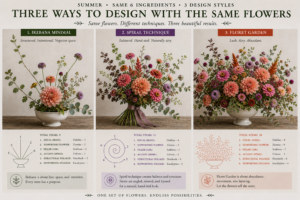
IngredientsSummer is where the contrast becomes extreme.
The same dahlia can look:
8–10 stems
20–24 stems
35–45 stems
IngredientsAutumn became dramatically better once I stopped treating dahlias as the main focal flower and leaned heavily into mums.
Mums create:
9–11 stems
20–24 stems
40+ stems
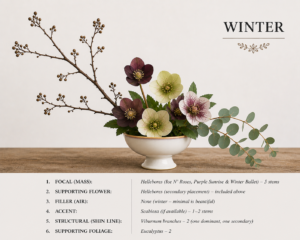
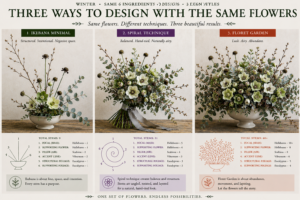
IngredientsWinter forced restraint.
Without a greenhouse or hoop house, winter arrangements naturally become simpler.
And honestly?
That simplicity made me better at arranging.
Winter forced me to focus on:
This is where Ikebana minimalism naturally shines.
8–10 stems
18–22 stems
35–40 stems
Below, you would see all three styles side by side:
Same flowers.
Completely different feeling.
This is where it becomes personal.
Do I want:
None of these styles are “better.”
They simply create different emotions using the same ingredients.
Some of my favorite arrangements used fewer than 10 stems.
One good branch can completely change an arrangement.
The same flowers can become:
…depending entirely on mechanics and structure.
I used to think I needed more flowers.
Now I think I needed:
Same ingredients.
Different mechanics.
Completely different result.
That is when arranging stopped feeling random…
…and started feeling like design.