Selected under North Carolina heat, humidity, and disease pressure—not greenhouse perfection.
Most gardeners save seed from their prettiest flower. I am doing something more demanding. This is a long-term zinnia breeding and selection project focused on developing large pastel zinnias in blush, champagne, muted buff, creamy pink, and soft peach tones that can perform in the heat, humidity, and disease pressure of Zone 8 North Carolina.
The goal is not to release ordinary zinnia seed. The goal is to build a seed line people remember. A seed line people ask about before it is ready. A seed line that carries a story: soft color, strong plants, careful selection, and real field pressure. This project is part garden trial, part breeding work, part climate test, and part long-term seed legacy.
I am not trying to create another generic pastel zinnia mix. I am trying to build a recognizable Fiora Lab pastel zinnia population: large, romantic, useful as cut flowers, selected under heat and humidity, and shaped by repeated culling over multiple generations.
In the future, if seed from this project becomes available, it will not be seed saved from random pretty blooms. It will be seed from selected survivors. That is what will make it different.
Zinnias are beloved because they are generous flowers. They bloom heavily, attract pollinators, fill summer gardens, and offer an extraordinary range of color and form.But not every zinnia performs equally in every climate.
A zinnia that looks flawless in a cooler or drier region may struggle in the Southeast. In Zone 8 North Carolina, zinnias face hot days, warm nights, heavy humidity, summer storms, bacterial stress, foliar disease, and powdery mildew pressure.This climate does not flatter weak plants.It exposes them.
A flower can be soft, pastel, romantic, and photogenic, but if the plant mildews early, produces weak stems, stops blooming, or collapses under humidity, it is not the plant I want to build from.
That is the foundation of this project:
Not from hype.Not from a filtered photo.Not from one lucky bloom.From repeated selection.
Zinnias have a long and serious breeding history. The genus Zinnia is native mainly to tropical and subtropical regions of North and Central America, with Mexico recognized as a major center of diversity. Several species, including Zinnia elegans, Zinnia haageana, Zinnia angustifolia, and Zinnia peruviana, became important in ornamental horticulture after introduction into European gardens during the 18th and 19th centuries.
Modern zinnias now include dwarf bedding types, landscape types, bicolor types, cactus forms, scabiosa forms, and tall cut-flower cultivars such as ‘Benary’s Giant’, ‘Envy’, and ‘Zinderella’.That history matters because this project is not simply about planting seed and hoping.Zinnia breeding has always depended on variation, selection, hybridization, flower form, plant habit, and adaptation.
Recent zinnia breeding literature emphasizes the need for cultivars that combine ornamental quality with disease resistance, stress adaptability, high-temperature and high-humidity performance, and postharvest cut-flower value.That is exactly the space Fiora Lab is working in.Soft pastel zinnias are beautiful.
But the real prize is soft pastel zinnias that can keep producing when the garden gets difficult.
Pastel zinnias look gentle, but genetically they are not simple. A soft blush flower does not guarantee soft blush seedlings. A champagne bloom does not guarantee champagne offspring. Seed saved from a beautiful, muted flower can produce bright pink, magenta, salmon, orange, cream, white, lavender, rose, or muddy intermediate colors in the next generation.
That variability is not failure. It is the breeding material. Research on zinnia flower color shows that petal color is influenced by multiple pigment systems, including anthocyanins and carotenoids, along with pigment distribution and regulatory genes. Studies on Zinnia elegans have identified genes and pathways involved in cyanidin synthesis, anthocyanin regulation, carotenoid accumulation, carotenoid degradation, and petal coloration. In garden language, pastel is not just “light pink.” Pastel is balance.
It may involve lower pigment intensity, softened anthocyanin expression, modified carotenoid influence, creamy backgrounds, aging behavior, fading behavior, and lower saturation. That is why these seeds cannot be rushed. One beautiful flower is not enough. A meaningful seed line needs repetition. Grow. Observe. Cull. Save. Repeat.
That is how a rare color direction becomes more than an accident.
The long-term goal is to develop a climate-selected pastel zinnia population with:
This is not a claim of disease immunity.That would be dishonest.The goal is selection pressure.
Every season, the plants are asked the same questions:
One reason I included Benary’s Giant genetics in the founding population is because I do not want a pastel zinnia line that only looks good in photographs.I want structure.I want stems.I want large blooms with enough plant strength underneath them.
Benary’s Giant zinnias are valued in the cut-flower world for large double blooms, long stems, and strong floral presence. They are not immune to disease, but they bring important cut-flower architecture into the project.That matters because many pastel zinnia projects chase the flower first.Soft color. Unusual tone. Pretty bloom.Those things matter to me too.But they are not enough.
A future Fiora Lab zinnia seed line should make people want the seed because the plant has been selected with more discipline than that.I want flowers that feel rare, but plants that are not fragile.I want softness without weakness.I want pastel without collapse.The goal is not simply pastel flowers.The goal is pastel flowers on strong plants.
Powdery mildew is one of the biggest challenges for zinnias in humid climates.Research confirms what many Southeastern growers already know: Zinnia elegans is susceptible to several important diseases, including powdery mildew, Alternaria blight, and bacterial leaf and flower spot.That is why disease pressure must be part of selection.
Gombert, Windham, and Hamilton evaluated disease resistance among 57 zinnia cultivars over a 17-week period. Their work showed that disease response varies among cultivars, and that early performance does not always tell the full story.This matters for my project because a plant that looks beautiful in early summer may not be the plant that holds up later.I need to know what survives the difficult part of the season.
Disease resistance has also shaped modern zinnia breeding. Zinnia marylandica, the background behind well-known landscape zinnias such as Profusion and Zahara, came from hybridization work involving Z. elegans and Z. angustifolia. The strong disease resistance associated with those lines is linked especially to the Z. angustifolia contribution.
That does not mean my pastel cut-flower line will behave like Profusion or Zahara.It means the principle is proven:Disease response matters. Genetics matter. Selection matters.
This project begins with open-pollinated and commercially sourced zinnia populations selected for pastel tendencies, warm color influence, large blooms, and cut-flower potential.
The main pastel parent population includes:
These are not being used to recreate an existing commercial variety.They are being used as a foundation.The goal is to create a locally selected pastel zinnia population shaped by Fiora Lab’s own field conditions, selection standards, and long-term vision.
In addition to the main pastel-focused population, I may also maintain a smaller hidden-genetics expansion block.This block would not replace the main pastel line.It would serve as a reserve source of genetic diversity.
The reason is simple: useful traits are not always visible in the first generation.Some zinnias may carry hidden genetics for antique tones, bicolor expression, unusual petal shape, branching strength, fading behavior, warmth, or color modifiers that only become useful after recombination in later generations.
Zinnia breeding history supports this idea. Zinnia haageana is known for bicolored flower cultivars, and its natural hybridization with Z. elegans may have introduced bicolor traits into modern zinnia cultivars. Research also notes that many genetic resources in zinnia remain underused.For a small breeding project, that means older mixes and warm-spectrum populations may still hide useful traits.
The possible hidden-genetics block would include:
This block must be handled with discipline.The main project is still pastel.The hidden-genetics block is only useful if it eventually contributes something valuable to blush, champagne, muted buff, creamy pink, soft peach, strong stems, better plant health, or more interesting flower form.
Most plants from this block will probably not be selected directly.That is expected.Their value may be in what they carry, not what they immediately show.The goal is not chaos.The goal is controlled diversity.
This project is being grown in an open-field breeding space. That means plants are exposed to real garden pressure and natural pollination. Most zinnias, except Z. peruviana, are naturally outcrossing plants with low self-pollination rates. This outcrossing tendency maintains genetic diversity and creates variation in offspring.
For this project, that variation is useful. I am not trying to control every cross in the beginning. I am trying to grow enough diversity to let rare combinations appear.
Then I select hard. That is where the future value of the seed comes from. Not every plant gets to contribute. Not every pretty bloom gets saved. The seed is earned.
The first visible priority is color.For this line, pastel does not mean any pale flower.I am selecting for low-saturation, soft, muted tones that feel aged, romantic, and gentle rather than bright, neon, harsh, or overly saturated.
The target range includes:
Using the Benjamin Moore fan deck as a visual reference, selected blooms should fall near soft pale blush and muted creamy-pink pastel families.
Flowers will be culled from this line if they are:
A flower can have perfect form, but if the color is wrong, it does not move this line forward.This is what will make the future seed desirable.Not every plant gets to be part of the color story.
Once a plant is in the right color range, flower form becomes the next major selection priority.Zinnia flower form has real genetic complexity. Research on doubleness and capitulum structure shows that double-flowered traits depend on the number and arrangement of ray florets. Seed selection may also influence the proportion of double-flowered offspring.
That matters because I am not only selecting color.I am selecting architecture.
The three main flower-form directions are:
Color first. Form second. Plant health always.
This is where Fiora Lab seed should eventually become hard to ignore. The seed will not come from every flower. It will come from plants that made it through selection. A weak plant with one perfect bloom is still a weak plant.
A strong, productive plant with good color, usable form, and better health may be far more valuable.
I am not using greenhouse protection to hide these conditions.The climate is part of the test.Research on zinnia stress response supports the importance of selection under stress. Studies have shown variation among zinnia cultivars in response to salinity, drought, transpiration, and stress recovery. Some cultivars maintain ornamental value better than others under challenging conditions.
My stress environment is heat, humidity, and disease pressure.The plants that keep blooming here are the ones I want.
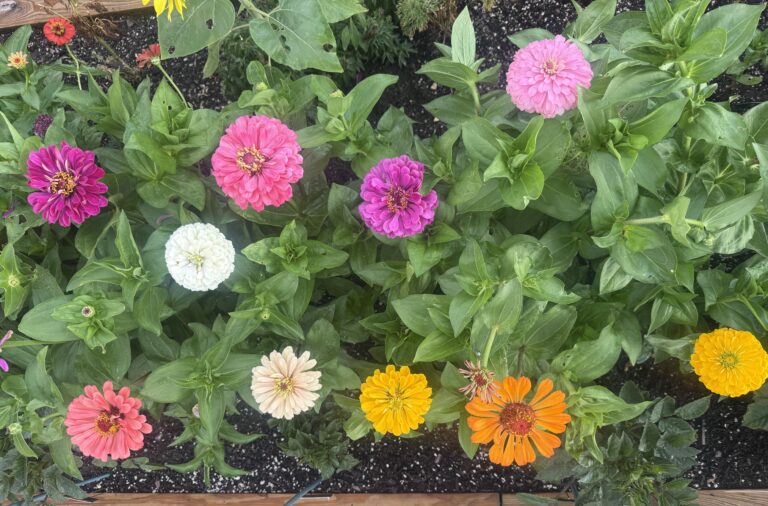
Spot the 2 pastel zinnias Click on the link to view the video.
I used succession planting to grow more potential parent plants across the season.
Succession planting gives the trial several advantages.
In a hot, humid climate, timing matters. A plant that looks clean in early summer may not look clean in late summer. The goal this year is not speed. The goal is better parents.
Seed will be collected only from fully mature flower heads on selected plants. Whenever possible, seed will be kept separated by individual mother plant. This allows family lines to be compared in future generations. That matters because the best-looking mother plant is not always the best genetic parent. By keeping seed separated, I can observe which plants pass useful traits to their offspring.
After harvest, I will hand-select seed. Small, flat, weak, damaged, underdeveloped, or poorly formed seeds will be discarded. Only the best-quality seed from selected mother plants will be kept. Seed saving is not just collecting. Seed saving is selection. The next generation begins with the choices made at harvest.
Because this is a cut-flower zinnia project, stem quality matters. A flower can be beautiful in the garden but disappointing in the vase if the stems are weak, short, crooked, or quick to wilt.
Postharvest research supports the importance of cut-flower handling and selection. Studies have examined postharvest senescence in Zinnia elegans, the effect of water quality on vase life, and methods for improving hydration and vase life in cut zinnias. For this project, that means selected plants must offer more than color.
They must offer usable stems. Future Fiora Lab pastel zinnia seeds should appeal to gardeners, flower farmers, floral designers, and cut-flower growers who want soft colors with real field usefulness.
I do not want these seeds to feel like something you toss into a cart without thinking. I want them to feel like something you followed from the beginning.
Something you watched being built. Something selected with enough discipline that availability may be limited, but meaningful. If Fiora Lab releases commercial seed from this project in the future, it will not be because every plant was perfect.
It will be because certain plants were worth trusting. That is the difference between ordinary seed and breeding-work seed. Ordinary seed says: Here is a color mix. This project says:
Here is a population that survived selection. Here is a line shaped by heat, humidity, powdery mildew pressure, stem evaluation, flower form, and color discipline. Here is seed with a story. That is why people should want it before it is even available.
Many gardeners buy new zinnia seed every year from lines selected in completely different climates. That can work. But it can also mean the same problems repeat every season.
The flowers may be beautiful, but the plants may not be adapted to a gardener’s heat, humidity, disease pressure, soil, rainfall, or growing season. Climate-selected seed is different. When seed is saved only from the healthiest and most useful plants in a specific environment, the next generation begins with parents that already survived that environment.
Over time, that repeated pressure can gradually create a population better suited to those conditions.
This does not happen in one season. It happens through repetition. Grow the plants. Watch them honestly. Cull the weak ones. Save seed from the strongest. Repeat. That is the heart of this project.
I am not simply trying to grow pastel zinnias. I am trying to build pastel zinnia seed selected under real heat, humidity, and powdery mildew pressure.
Future Fiora Lab zinnia seeds will not be for everyone.They will be for growers who understand that rare seed is not just about rarity.It is about selection.
These seeds will be for people searching for:
The value will not be only in the color.The value will be in the work behind the color.Every future release will represent plants that were observed, compared, culled, and selected.
That means buyers will not simply be growing pastel zinnias.They will be growing the next chapter of a living breeding project.
This is not a one-season project.Success this year does not mean creating a finished pastel zinnia variety.
Early success may look like:
That is enough.One good mother plant can move the project forward.One strong family can become the foundation for future seed.
The long-term vision is to develop Fiora Lab pastel zinnia seeds that are beautiful, useful, and honest.I want these seeds to carry the softness people love in boutique cut flowers, but with the practical strength needed for real gardens.The final goal is a population that produces:
Each line would come from the same philosophy:Beauty selected under pressure.
Plant breeding is slow, cumulative work.Each generation reduces uncertainty.Each selection cycle teaches me which traits are stable, which traits disappear, and which plants are worth trusting.The new pastel seed trial from FP and DFF may speed up the color side of this project. The hidden-genetics block may reveal unexpected antique tones, bicolor modifiers, or flower forms. The Benary’s Giant and California Giant influence may help strengthen stems and bloom size.
But every plant still has to prove itself here.In this garden.In this climate.Under this pressure.That is what will make future Fiora Lab zinnia seeds worth wanting.They will not just be seeds from pretty flowers.
They will be seeds from selected survivors Soft color.Strong plants.Honest field selection.That is the future of this pastel zinnia breeding project.